

CCTV Camera Types: 7 Proven Choices to Avoid Bad Coverage
A camera above the front door may deter opportunistic theft, but it will not necessarily identify a face at the gate or cover vehicles parked on the street. Choosing between CCTV camera types is about matching the camera to the risk, the viewing distance and the area you need to protect. For homes, complexes, shops, offices and warehouses, the right layout matters as much as the equipment itself.
A good CCTV installation should give you useful evidence when you need it, without creating blind spots, poor night footage or a system that is difficult to check. Start with the places where people enter, leave, park, handle stock or access valuable equipment. Then choose cameras that suit those specific locations.
Table of Contents
The main CCTV camera types
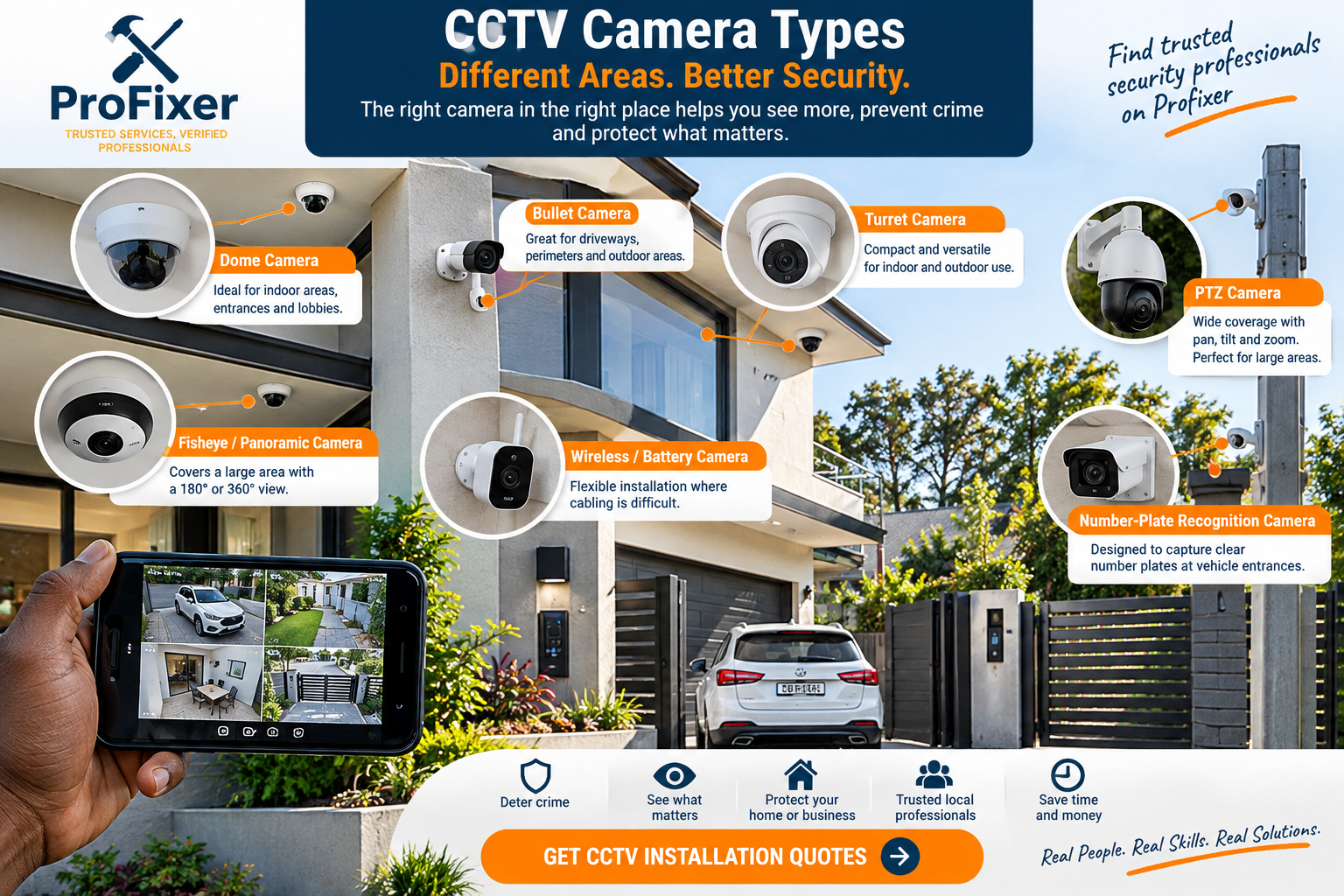
Dome cameras
Dome cameras sit inside a rounded housing and are commonly fitted to ceilings, entrance canopies and indoor corridors. Their discreet shape makes it harder for someone to tell exactly which direction the lens is facing, while the housing helps protect the camera from casual tampering.
They are a practical option for reception areas, retail floors, lobbies, covered patios and shared passages. Outdoor-rated dome cameras can work well under eaves, but check the weatherproof rating before placing one where it will face heavy rain, dust or direct sun.
The trade-off is access. A dome camera mounted high on a ceiling can be more awkward to clean or adjust than a wall-mounted model. Low-quality domes may also produce glare at night if their infrared light reflects off the cover.
Bullet cameras
Bullet cameras have the familiar long, tubular shape and are usually mounted on an exterior wall or under a roofline. They are visible, which can be useful when you want the camera to act as a clear deterrent at a driveway, gate, perimeter fence or loading area.
Because they are easier to aim, bullet cameras are often chosen for narrow views over a path, side passage or vehicle entrance. A properly positioned model can capture a useful approach view rather than simply recording a person from too far away.
Their visible design is not always ideal for indoor areas where a discreet appearance is preferred. They can also be easier to reach and interfere with if installed too low, so placement is essential.
Turret or eyeball cameras
Turret cameras combine the compact look of a dome with an exposed, adjustable lens module. They are widely used for homes and small businesses because installers can position the lens accurately without working inside a full dome cover.
They suit entrances, patios, verandas, shop counters and indoor-outdoor transition areas. Turrets often handle night vision well because there is less chance of infrared reflection from a clear dome cover. They are not as covert as some dome cameras, but they look neat and are easy to direct at the important part of a scene.
PTZ cameras
PTZ stands for pan, tilt and zoom. These cameras can turn across a wide area, tilt up and down, and zoom in on a selected point. They are useful for larger sites such as estates, warehouses, car parks, construction sites, school grounds and yards with several access points.
A PTZ camera is valuable when someone is actively monitoring footage or when the system can trigger preset positions after an alarm event. Optical zoom can provide detail at a distance that a fixed wide-angle camera cannot.
However, a PTZ camera cannot watch every direction at once. While it turns towards one area, another part of the site may be out of view. For this reason, it normally works best alongside fixed cameras covering entrances and critical zones. It is not usually the only camera a property needs.
Fisheye and panoramic cameras
Fisheye cameras use an ultra-wide lens to cover a large area, sometimes providing a 180-degree or 360-degree view. One unit can be useful in an open-plan office, retail space, reception area, warehouse aisle junction or small courtyard.
The benefit is broad coverage with fewer cameras. The limitation is detail at the edge of the image. A face or number plate may be too small to identify if the camera is mounted high and expected to cover a very large area. Ask whether the recording system can correct the curved image into clearer views for playback.
Wireless and battery cameras
Wireless cameras send footage over Wi-Fi rather than a network cable, while battery cameras can operate without a permanent power connection. They are popular where running cables would be difficult, such as a rented property, a temporary site or a small outbuilding.
Convenience has limits. Wi-Fi range, signal interference, battery charging and data use can affect reliability. A battery camera may record only when it detects movement, which can miss part of an event or create delays. For permanent security around a busy home or business, wired power and network connections are usually the more dependable choice.
Number-plate recognition cameras
Number-plate recognition cameras are designed for vehicle entrances. They use a narrow, carefully controlled view and settings that help capture plates despite headlights, speed or changing light conditions.
They are useful for gated communities, business premises, complexes, visitor parking and delivery entrances. A standard camera pointed broadly at a road or driveway may record a vehicle but still fail to read the plate. These specialist cameras need correct height, angle, distance and lighting, so installation planning is particularly important.
Choosing CCTV camera types by location
The best camera is rarely the most expensive one. It is the one that records the right detail in the right conditions. At a front gate, for example, you may need a fixed camera aimed at faces and a separate view for vehicles. At a back door, a turret or bullet camera with strong night performance is often more useful than a very wide view of the whole garden.
Inside a shop, dome or turret cameras can cover tills, stock areas and customer entrances without making the space feel overly industrial. A warehouse may need wide-angle coverage inside, fixed cameras at loading doors and a PTZ camera for the yard. For flats and rental properties, landlords should also consider privacy carefully and avoid recording areas where occupants have a reasonable expectation of privacy.
Do not choose based on megapixels alone. Higher resolution can improve detail, but it also requires more storage and bandwidth. Lens angle, lighting, mounting height and the distance from the subject all affect whether footage is actually usable. A camera recording a wide 20-metre driveway may show movement clearly but not provide a recognisable face.
Features worth discussing with an installer
Different CCTV camera types perform differently after dark, over long distances and in changing light, so specifications should be matched to each camera position rather than applied to the whole property.
When comparing quotations, ask how the cameras will perform after dark, not only in daytime demonstrations. Infrared night vision is common, but colour night vision can be helpful where there is enough ambient light. Motion-activated lights may improve footage around doors, gates and parking areas, although they must be positioned so they do not cause glare.
You should also ask how long footage will be retained, whether you can view cameras remotely, and what happens during load shedding or an internet outage. A local recorder with suitable backup power can keep recording even when the internet is down. Remote viewing, alerts and cloud storage are useful additions, but they should not be the only plan for retaining footage.
Other practical questions include who owns the login details, whether the system can be expanded, how cables will be protected, and whether the quotation includes setup, testing and basic user training. For commercial properties, access permissions and password management matter just as much as image quality.
Plan the system before buying cameras
Comparing CCTV camera types becomes much easier once you know whether each location needs general detection, person recognition, facial identification or vehicle number-plate detail.
A quick site assessment can prevent expensive mistakes. Walk the property at the time of day when visibility is most difficult. Look for direct sunlight, streetlights, trees that may grow into the view, gates that open across the frame and areas where a person could approach unseen.
Mark the priority zones first: entry points, vehicles, cash-handling areas, high-value stock, boundary access and equipment rooms. Then decide what you need to see at each point. Detecting movement, recognising a person and identifying a face are different requirements, and they may call for different camera positions.
With Profixer, you can post your CCTV installation project free and connect with local security contractors interested in quoting for the work. Include the property type, areas you want covered, night-time requirements, recording period, remote-viewing needs and any existing security equipment so contractors can recommend a suitable camera layout.
The most useful security system is one you can rely on when something happens. Choose cameras for the scene they must capture, allow for proper recording and power backup, and make sure the installer shows you how to use the system before they leave.
Choosing the right CCTV camera types is less about buying the highest specification and more about capturing the detail you actually need. Match each camera to the scene, viewing distance and lighting conditions, allow for reliable recording and backup power, and compare installers who can explain why each camera has been positioned where it is.
GET CCTV INSTALLATION QUOTES