
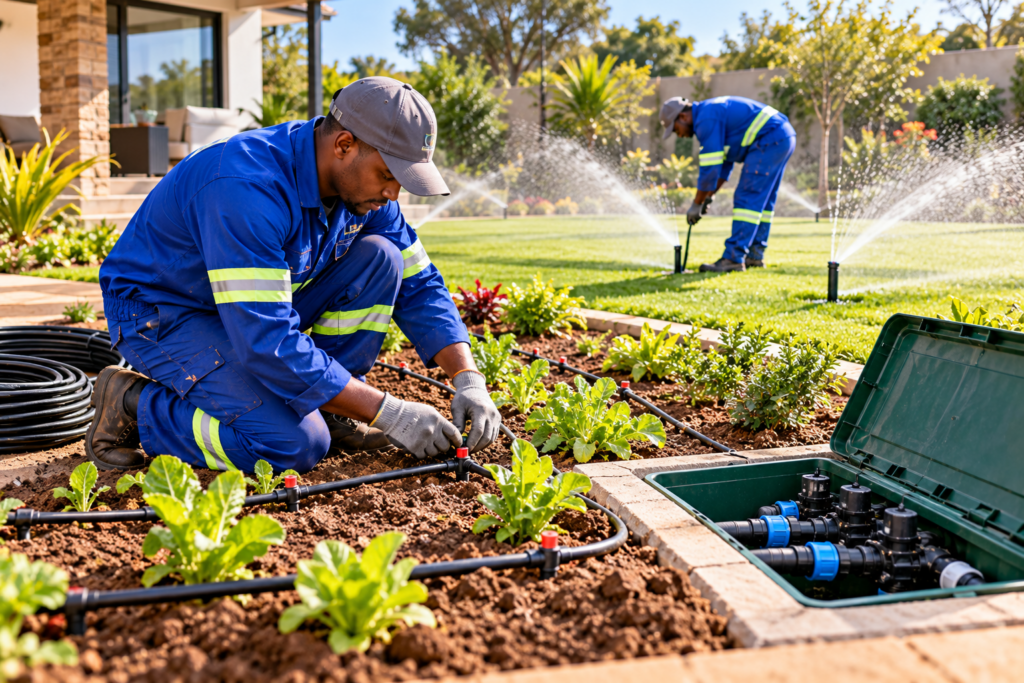
Find Trusted Irrigation System Installers Near You
A properly designed irrigation system can save time, reduce water waste and help lawns, gardens, vegetable beds and crops receive water more consistently. Whether the water comes from a municipal supply, storage tank or borehole, the system needs to provide the right pressure and flow to each area.
Professional irrigation system installers can design, install, repair and upgrade systems for homes, farms, gardens, greenhouses and commercial properties. They can help with sprinkler systems, drip irrigation, controllers, valves, filters, pumps and automated watering schedules.
ProFixer makes it easier to connect with suitable local contractors. Post your irrigation job free, describe the area you want to water and compare up to three no-obligation quotes from installers serving your area.
Table of Contents
Why Hire Professional Irrigation System Installers?
An irrigation system needs more than pipes and sprinklers.
The installer must consider the available water supply, pressure, flow rate, garden size, plant types, soil conditions and elevation changes.
If too many sprinklers are connected to one zone, pressure may drop and some areas may receive very little water. Poorly positioned sprinklers can also waste water on paving, walls and driveways.
Experienced irrigation system installers can divide the property into suitable zones and choose components that work together.
How to Find Irrigation Installers Near Me
When searching for irrigation installers near me, provide contractors with as much information as possible.
Useful details include the property size, existing water source, areas that need irrigation and whether you already have an irrigation system.
Photographs or a simple sketch of the garden can help contractors understand the layout.
For larger properties, farms or commercial sites, a site visit will normally be needed before a final design and quotation can be prepared.
Garden Irrigation Systems
Professional garden irrigation systems can automatically water lawns, flower beds, shrubs and trees.
Different areas often need different watering methods.
Lawns may use pop-up sprinklers, while planting beds may be better suited to drip irrigation.
A well-designed system allows each zone to run independently.
Automatic Irrigation Systems
Automatic systems use a controller to start and stop irrigation at programmed times.
This means the garden can be watered even when nobody is at home.
Controllers can operate several zones and allow different watering times for lawns, beds and other areas.
Lawn Irrigation Systems
Lawns generally need even water coverage.
Pop-up sprinklers are commonly used because they remain below ground when not operating.
The installer should arrange sprinkler positions so the spray patterns overlap correctly.
Poor spacing can create dry patches between sprinklers.
Pop-Up Sprinkler Installation
Pop-up sprinklers rise when water pressure is applied and retract when the zone switches off.
They can provide a neat solution for lawns because the sprinkler bodies remain below the mowing level.
The installer needs to position them carefully so they are not damaged by vehicles, lawn equipment or foot traffic.
Rotary Sprinklers
Rotary sprinklers are useful for larger lawn areas.
They distribute water over longer distances than many fixed spray heads.
Pressure and spacing need to be correct for effective coverage.
Spray Sprinklers
Fixed spray heads can be useful for smaller lawn sections and narrow areas.
Nozzles are available with different spray patterns and distances.
The contractor should select nozzles that match the shape of the area rather than allowing excessive overspray.
Sprinkler System Installers
Professional sprinkler system installers can design systems that provide balanced coverage across the property.
They can calculate how many sprinklers should operate at the same time and divide them into zones where required.
A properly designed system should provide usable pressure to all active sprinklers.
Drip Irrigation Installation
Drip irrigation installation delivers water slowly near plant roots.
It can be particularly useful for:
- Vegetable gardens
- Flower beds
- Shrubs
- Hedges
- Orchards
- Greenhouses
Because water is applied directly to the planting area, drip irrigation can reduce unnecessary evaporation and overspray.
Drip Lines
Drip lines contain small emitters that release water at controlled intervals.
They can be laid along plant rows or around planting beds.
Spacing should suit the plants and soil conditions.
Individual Drippers
Individual emitters may be installed beside specific plants.
This can be useful for trees, large shrubs or container plants.
Different emitters can provide different flow rates.
Drip Irrigation for Vegetable Gardens
Vegetable gardens benefit from regular and controlled watering.
Drip irrigation can deliver water close to the roots without wetting the entire garden surface.
It can also make it easier to divide vegetables into irrigation zones.
Drip Irrigation for Orchards
Fruit trees may require individual irrigation points or rings around the root area.
The required water quantity changes as trees mature.
Systems should therefore be designed so flow can be adjusted over time.
Irrigation for Hedges
Long hedges are well suited to drip irrigation.
A line can run along the base of the hedge and provide consistent watering along its length.
Filtration is important to prevent emitters from becoming blocked.
Irrigation for Flower Beds
Flower beds may use drip lines, micro-sprayers or a combination of both.
The correct method depends on planting density and the type of plants.
Irrigation for Trees
Trees may need deeper watering than shallow-rooted plants.
The system should deliver water to the root area rather than only wetting the surface near the trunk.
Irrigation for Greenhouses
Greenhouses can use drip lines, micro-sprayers or individual plant emitters.
The system should allow precise control because greenhouse crops may have different watering needs from outdoor gardens.
Automatic control can be especially useful where plants need frequent watering.
Irrigation for Farms
Farm irrigation systems may be considerably larger than residential systems.
They can supply vegetable fields, orchards, livestock areas or other crops.
The design should consider available water volume, pump capacity and the amount of land being irrigated.
For borehole-fed farms, compare borehole drilling contrBorehole Drilling Contractorsactors through ProFixer.
Irrigation Zones
Dividing an irrigation system into zones allows different areas to water separately.
This is important because lawns, shrubs, vegetable gardens and trees may need different amounts of water.
Zones also help prevent too many sprinklers from operating at once and reducing pressure.
Irrigation Zone Planning
The contractor should group areas with similar watering requirements.
For example, lawn sprinklers should not normally share the same zone as low-flow drip irrigation.
The two systems operate at different pressures and flow rates.
Solenoid Valves
Automatic irrigation zones are usually controlled by electrically operated valves.
The controller sends a signal to open one valve at a time.
Valves should be installed where they can be accessed for future maintenance.
Irrigation Valve Boxes
Valve boxes protect valves while keeping them accessible.
They are normally installed close to ground level.
The box should not be buried beneath paving or permanent structures.
Irrigation Controllers
The controller is the main control point for an automatic system.
It determines which zones operate and how long they run.
Simple controllers may operate a few zones, while larger systems can manage many areas.
Smart Irrigation Controllers
Some modern controllers can connect to Wi-Fi and allow schedules to be adjusted from a phone.
Advanced systems may also respond to weather information or sensors.
The most appropriate controller depends on the size and complexity of the system.
Irrigation Timers
Basic timers can be useful for smaller systems.
They may connect directly to a tap or control a limited number of valves.
They are generally simpler than a full multi-zone irrigation controller.
Rain Sensors
Rain sensors can prevent automatic irrigation from running during or shortly after rainfall.
This can reduce unnecessary watering.
The sensor should be installed where it can detect natural rainfall accurately.
Soil Moisture Sensors
Some irrigation systems use soil moisture sensors to determine whether watering is required.
These systems can help avoid unnecessary irrigation where the soil is already sufficiently wet.
Irrigation Filters
Filters are particularly important for drip irrigation.
Small emitters can become blocked by sediment.
Borehole and tank-fed systems may need filtration before water enters the irrigation network.
Disc Filters
Disc filters are commonly used where fine particles need to be removed.
They can be cleaned and reused.
The filter size should match the required flow.
Screen Filters
Screen filters can help remove larger particles.
They may be used in residential irrigation systems or as part of a multi-stage filtration arrangement.
Irrigation Pressure Regulation
Drip irrigation usually operates at lower pressure than many sprinkler systems.
Pressure regulators can reduce pressure before water enters the drip lines.
Excessive pressure can damage fittings or cause emitters to operate incorrectly.
Water Pressure for Irrigation
Before designing the system, the installer should measure available pressure and flow.
Pressure alone does not determine how many sprinklers can operate.
The system also needs enough water volume.
Irrigation Flow Rate
Flow rate determines how much water can pass through the system at a given time.
This affects how many sprinklers or emitters can operate within one zone.
A system with insufficient flow should be divided into more zones rather than simply fitting a larger number of sprinklers.
Irrigation Pipe Sizing
Pipe diameter affects pressure loss.
Long pipe runs or high-flow zones may require larger pipe.
Using pipe that is too small can reduce performance at the far end of the system.
Main Irrigation Lines
The main line carries water from the supply to valves or distribution points.
It should be sized for the maximum expected system flow.
Irrigation Laterals
Lateral pipes carry water from valves to sprinklers or drip zones.
Their size depends on the number of outlets and required flow.
Underground Irrigation Pipes
Most residential irrigation pipes are buried to protect them and keep the garden tidy.
The installation depth should reduce the risk of damage during normal gardening.
The route should be planned before paving, landscaping or major planting is completed.
Irrigation Trenching
Installing an underground system usually involves trenching across the garden.
Contractors should plan pipe routes to minimise unnecessary disturbance.
Lawns and beds should be reinstated as neatly as possible after installation.
Irrigation Before Landscaping
The best time to install irrigation is often before final landscaping is completed.
Pipes, cables and valves can be installed before lawns, paving and planting are finished.
For complete garden projects, compare landscaping contractors through ProFixer.
Irrigation After Landscaping
Existing gardens can still be fitted with irrigation.
The contractor should plan routes carefully to avoid damaging established plants, trees and paving.
Some sections may need to be installed manually where machinery cannot access.
Borehole-Fed Irrigation
A borehole can be an effective water source for irrigation.
However, the irrigation demand should not exceed the sustainable borehole yield.
A low-yield borehole may need to pump into a storage tank before the irrigation system operates.
For borehole installations, compare borehole drilling contractors through ProFixer.
Borehole Pump and Irrigation Integration
The borehole pump should be selected with the irrigation requirements in mind.
Sprinklers may require significantly more flow and pressure than household taps.
The pump contractor and irrigation installer should coordinate the system design.
Irrigation from Storage Tanks
Irrigation can be supplied from a storage tank rather than directly from the main water source.
A separate booster pump may provide pressure to the irrigation system.
This setup can work well with boreholes or harvested water.
Irrigation Booster Pumps
A booster pump increases pressure and flow from storage tanks.
The pump should be sized for the largest irrigation zone.
An oversized pump may waste energy and create excessive pressure.
Irrigation Pump Installation
Pump installation may include a pump, control system, non-return valve, filters and pressure protection.
Electrical requirements should also be considered.
For pump electrical supplies, compare electrical servicFind Local Electricianses through ProFixer.
Irrigation Connected to Municipal Water
Residential irrigation systems can also connect to municipal water.
Pressure and available flow should be checked before the design is finalised.
Local water restrictions should also be considered when programming schedules.
Irrigation for Large Gardens
Large gardens often require several irrigation zones.
Lawns, beds and trees can be controlled independently.
A central controller can automate the entire system.
Irrigation for Small Gardens
Small gardens may use a simpler system with a few sprinklers or drip lines.
Even small installations benefit from proper pressure regulation and filtration.
Irrigation for Townhouses
Townhouse gardens often have limited space.
Drip irrigation and compact sprinklers can provide effective watering without excessive overspray onto neighbouring properties.
Irrigation for Estates and Complexes
Residential estates may require irrigation for communal gardens, entrances, lawns and landscaped areas.
Larger systems can use many zones controlled from one or several controllers.
Maintenance access should be considered during design.
Irrigation for Commercial Properties
Commercial properties may need irrigation for landscaped entrances, lawns and gardens.
Automatic systems help ensure watering takes place consistently outside business hours.
Irrigation for Schools
Schools can have large lawns and landscaped areas.
Irrigation may be scheduled early in the morning or after hours to reduce interference with students and activities.
Irrigation for Sports Fields
Sports fields require even coverage.
Large sprinklers or specialised systems may be used depending on field size.
Pressure and flow requirements can be significant.
Irrigation for Vegetable Farms
Vegetable farms frequently use drip irrigation because it can provide controlled water directly to crop rows.
Filters and pressure regulation are especially important.
The irrigation design should match the available water supply.
Irrigation for Orchards
Orchards may use drip emitters or micro-sprinklers.
The system should be expandable as trees mature.
Irrigation for Nurseries
Nurseries may require frequent watering across many containers or growing areas.
Micro-sprayers, drip systems and automated scheduling can reduce manual labour.
Irrigation for Greenhouses
Greenhouses often benefit from automatic irrigation because plants can dry quickly in warm conditions.
Different sections can be divided into zones based on plant requirements.
Irrigation for Hydroponic Areas
Some farms may need water distribution systems for hydroponic growing areas.
These systems should be designed around the specific crop and growing method.
They are different from conventional garden irrigation and may require specialist equipment.
Irrigation System Repairs
Existing systems can develop leaks, blocked sprinklers, electrical faults and pressure problems.
Professional contractors can test the system and identify which components need repair.
Replacing individual parts may be more cost-effective than installing a completely new system.
Leaking Irrigation Pipes
Underground pipe leaks can create wet patches, reduced pressure or unexpectedly high water use.
The damaged section needs to be located before excavation begins.
Once repaired, the system should be pressure-tested.
Broken Sprinklers
Sprinklers can be damaged by lawnmowers, vehicles, gardening tools or general wear.
Broken heads should be replaced with compatible units.
The replacement nozzle should also match the rest of the zone.
Sprinkler Not Popping Up
A pop-up sprinkler may fail to rise due to low pressure, dirt, damaged internal parts or a leak elsewhere in the zone.
The installer should investigate the cause before simply replacing the sprinkler.
Sprinkler Not Rotating
Rotary sprinklers can stop turning if internal mechanisms become blocked or worn.
Cleaning may solve the problem, but older units may require replacement.
Blocked Sprinkler Nozzles
Sand and debris can block small nozzle openings.
This can distort the spray pattern and leave dry areas.
Filters and regular cleaning can reduce these problems.
Blocked Drip Emitters
Drip emitters have very small openings and can block if filtration is inadequate.
Mineral deposits can also affect performance.
The installer should check both the emitters and filtration system.
Low Irrigation Pressure
Low pressure may be caused by:
- Pipe leaks
- Too many sprinklers on one zone
- Blocked filters
- Undersized pipes
- Pump problems
- Poorly adjusted valves
The system should be tested before equipment is replaced.
Irrigation Pressure Too High
Excessive pressure can cause misting, leaks and premature fitting failure.
Pressure regulators can help protect low-pressure systems.
Uneven Sprinkler Coverage
Dry areas between sprinklers usually indicate poor spacing, blocked nozzles or incorrect pressure.
The solution may involve nozzle adjustment, repositioning or adding additional sprinklers.
Sprinklers Watering Paving
Overspray wastes water and can stain paving or walls.
Sprinkler arcs and distances should be adjusted so water remains within landscaped areas.
Irrigation Controller Not Working
Controller faults can prevent zones from operating.
Possible causes include power failure, damaged wiring or a controller fault.
The contractor should check the controller before replacing valves or sprinklers unnecessarily.
Irrigation Zone Not Working
If one zone stops operating while others still work, the problem may involve the solenoid valve, field wiring or controller output.
Testing can help identify the faulty component.
Solenoid Valve Repairs
Valves can fail electrically or mechanically.
Dirt can also prevent them from closing properly, causing zones to continue watering.
Valves should be accessible so they can be serviced without major excavation.
Irrigation System Running Continuously
A zone that will not switch off may have a stuck valve or controller problem.
The water supply may need to be isolated until the fault is repaired.
Irrigation Timer Problems
Incorrect programming can cause systems to water at unexpected times.
Before assuming equipment has failed, the schedule should be checked carefully.
Irrigation Electrical Faults
Automatic systems use low-voltage wiring between the controller and valves.
Damaged underground cables can prevent individual zones from working.
For more substantial electrical work, compare electrical services through ProFixer.
Irrigation Pump Not Starting
Pump faults may involve electrical supply, controls, low-water protection or the pump itself.
The system should be tested before the pump is removed.
Irrigation Pump Running but No Water
A running pump may fail to deliver water because of low tank levels, blocked filters, pipe leaks or pump problems.
The cause should be identified before repeated restarting.
Irrigation Maintenance
Regular maintenance helps keep sprinklers and drip systems operating efficiently.
The system should be inspected periodically for leaks, blocked outlets and damaged equipment.
Controllers should also be checked to ensure schedules still suit the season.
Irrigation System Seasonal Adjustments
Plants generally need different amounts of water during different seasons.
Automatic schedules should be adjusted rather than running the same times throughout the year.
This can reduce unnecessary water use.
Irrigation Maintenance Before Summer
Before periods of higher watering demand, inspect sprinklers, filters, valves and controllers.
Repair leaks before increasing run times.
Irrigation Maintenance During Rainy Periods
Automatic irrigation may need to be reduced or temporarily switched off during periods of regular rainfall.
Rain sensors can help automate this.
Cleaning Irrigation Filters
Filters should be cleaned regularly, particularly on borehole and drip systems.
A blocked filter can significantly reduce pressure and flow.
Flushing Drip Irrigation Lines
Drip lines may need periodic flushing to remove sediment.
End caps or flushing points should be accessible.
Checking Sprinkler Alignment
Sprinklers can move slightly over time because of soil movement or gardening activities.
Their direction and height should be checked periodically.
Extending an Existing Irrigation System
New lawns, beds or extensions may require additional irrigation zones.
The installer should first confirm that the existing water supply and controller have enough capacity.
Irrigation During Landscaping Upgrades
When gardens are redesigned, irrigation should be adjusted to suit the new planting.
Old sprinkler positions may no longer provide suitable coverage.
For complete outdoor upgrades, compare landscaping contractors through ProFixer.
Irrigation and Garden Maintenance
Even a well-designed irrigation system does not replace normal garden maintenance.
Plants still need pruning, feeding and monitoring.
For ongoing garden care, compare garden maintenance services through ProFixer.
Irrigation and Property Maintenance
Leaks, pump faults and damaged valves can form part of wider property maintenance.
For multiple repair requirements, compare property maintenance contractors through ProFixer.
Water-Efficient Irrigation
Efficient irrigation focuses on applying the right amount of water to the right place.
This can involve:
- Drip irrigation
- Correct sprinkler spacing
- Zone control
- Rain sensors
- Suitable watering times
- Leak repairs
Efficiency often comes from good design rather than simply reducing run times.
Best Time to Run Irrigation
Early morning irrigation is commonly preferred because temperatures are cooler and evaporation is lower.
It also gives foliage time to dry during the day.
The best schedule still depends on climate, soil and plant requirements.
How Long Should Irrigation Run?
There is no single correct run time.
A lawn sprinkler may need a different duration from a drip irrigation zone.
The installer should consider flow rate, soil and plant type when setting the schedule.
Avoiding Overwatering
Too much water can be as harmful as too little.
Signs of overwatering may include constantly wet soil, fungal problems and water running away from the planting area.
Shorter or less frequent cycles may be appropriate depending on conditions.
Avoiding Underwatering
Dry patches, stressed plants and poor growth may indicate insufficient watering.
The problem may be caused by short run times or poor irrigation coverage.
Irrigation and Soil Type
Sandy soils drain quickly and may need shorter, more frequent watering.
Clay soils absorb water more slowly and may require longer gaps between cycles.
The irrigation schedule should reflect local soil conditions.
Irrigation on Sloping Ground
Slopes can cause water to run off before it soaks into the soil.
Shorter repeated watering cycles may help.
Drip irrigation can also work well on some sloped planting areas.
Irrigation System Final Testing
Once installation is complete, every zone should be tested.
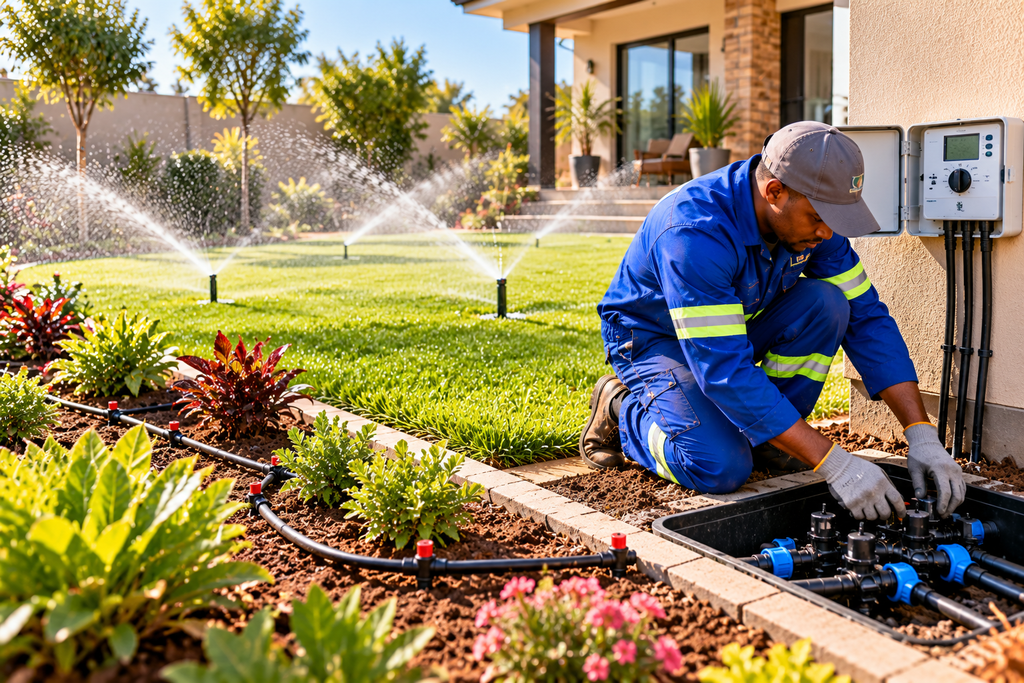
Sprinklers should rise correctly and cover the intended areas.
Drip emitters should deliver water consistently.
The installer should also check valves, controllers, pumps and filters.
Irrigation Controller Setup
The contractor should program the initial watering schedule and explain how to make adjustments.
Homeowners should know how to start or stop individual zones manually.
Checking for Irrigation Leaks
The system should be inspected while each zone is operating.
Wet patches or unexpected pressure drops can indicate leaks.
Checking Sprinkler Coverage
The installer should confirm that sprinklers overlap sufficiently without unnecessarily watering buildings or paving.
Checking Drip Irrigation Flow
Drip lines should be checked at both the beginning and end of the zone.
A large difference in performance may indicate a pressure or pipe-sizing issue.
What Affects Irrigation Installation Costs?
The cost of hiring irrigation system installers depends on the property size and complexity of the system.
Factors can include the number of zones, amount of pipework, type of sprinklers, controller, valves and water source.
Borehole, pump and storage-tank integration can add to the project cost.
Sprinkler System Costs
Sprinkler system costs depend on the number and type of sprinkler heads required.
Large lawns usually require more zones and pipework.
Drip Irrigation Costs
Drip systems may require less pressure but can involve many metres of drip line and numerous fittings.
Filters and regulators should also be included.
Irrigation Controller Costs
Controller prices vary according to the number of zones and available features.
Wi-Fi and smart controllers generally cost more than basic timers.
Irrigation Pump Costs
Where water is supplied from a tank or borehole, a suitable pump may be required.
The pump should be selected based on the actual system requirements.
Irrigation Repair Costs
Repair costs depend on the fault.
Replacing one sprinkler can be straightforward, while locating an underground pipe or cable fault can require more labour.
What Should an Irrigation Quote Include?
A good quotation should explain what is being supplied and installed.
It may include:
- Pipework
- Sprinklers
- Drip lines
- Valves
- Valve boxes
- Controller
- Filters
- Pressure regulators
- Pumps
- Trenching
- Labour
- Testing
Ask whether reinstating lawn or paving is included.
Supply and Installation or Labour Only?
Most complete irrigation projects are easier when one contractor supplies compatible components and installs the entire system.
However, labour-only arrangements may also be possible.
If you already have equipment, confirm that the installer considers it suitable for the planned system.
Questions to Ask Irrigation System Installers
Before choosing a contractor, ask how the irrigation zones will be designed and whether pressure and flow will be measured first.
Also confirm what controller, valves and sprinklers are included.
If the system will use borehole or tank water, ask whether pump and filtration requirements have been considered.
For larger projects, ask for a simple layout showing the proposed zones.
Compare Irrigation System Installers Through ProFixer
Choosing irrigation system installers is easier when you compare the complete design rather than only the headline installation cost.
One contractor may include automatic controls, filtration and pressure regulation, while another may quote mainly for pipes and sprinklers.
ProFixer allows you to post your irrigation project once and connect with suitable local professionals.
Provide photographs, the approximate garden or farm size, your water source and the areas that need irrigation.
Compare contractors based on system design, equipment, water efficiency, installation method, maintenance requirements and total cost.
Get Free Irrigation Installation Quotes
Whether you need irrigation installers near me, automated garden irrigation systems, professional drip irrigation installation or experienced sprinkler system installers, ProFixer can help you connect with suitable local professionals.
Compare up to three no-obligation quotes from local irrigation system installers.
GET FREE IRRIGATION QUOTES