
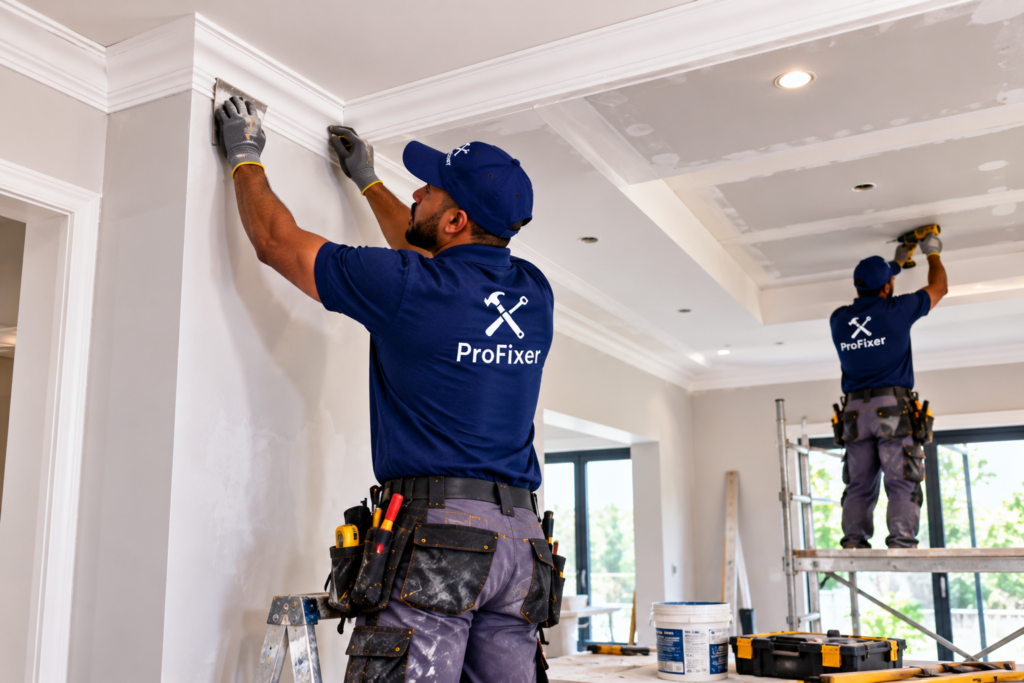
Find Trusted Ceiling and Cornice Contractors Near You
Ceilings and cornices play an important role in both the appearance and condition of a room. A well-finished ceiling can make an interior feel clean and complete, while neatly installed cornices create a smooth transition between walls and ceilings.
Professional ceiling and cornice contractors can assist with new installations, repairs, replacements, bulkheads, suspended ceilings, decorative cornices and finishing work. They can also help where ceilings have cracked, sagged, been damaged by water or need to be prepared for new lighting.
ProFixer makes it easier to connect with suitable local contractors. Post your ceiling or cornice job free, upload photographs where possible and compare up to three no-obligation quotes from contractors serving your area.
Table of Contents
Why Hire Professional Ceiling and Cornice Contractors?
Ceiling work often looks simple until the installation begins.
Boards need to be supported correctly, joints must be finished smoothly and cornices need to follow straight, consistent lines around the room.
Poor workmanship can lead to:
- Visible joints
- Cracks
- Sagging boards
- Uneven cornices
- Gaps at corners
- Poor paint finishes
Experienced ceiling and cornice contractors can assess the structure, choose the appropriate materials and complete the finishing work properly.
How to Find Ceiling Contractors Near Me
When searching for ceiling contractors near me, provide as much detail as possible.
Useful information includes the room size, ceiling height, type of existing ceiling, visible damage and whether new lighting is being installed.
Photographs are particularly useful where the ceiling is sagging, cracked or water-damaged.
For larger renovation projects, contractors may also need to inspect roof or floor structures above the ceiling before providing a final quotation.
Ceiling Installation Services
Professional ceiling installation services may include complete new ceilings, replacements or ceilings added during extensions and renovations.
A typical installation can involve framing or battens, ceiling boards, joint treatment, sanding and final preparation for paint.
The exact system depends on the room, structure and finish required.
Plasterboard Ceiling Installation
Plasterboard is widely used for residential ceilings because it creates a smooth surface ready for finishing and painting.
Boards should be fixed securely to suitable supports and installed with the correct spacing.
Joints are then taped and finished so they become less visible after painting.
For related wall and partition work, compare drywall contractors through ProFixer.
Ceiling Board Installation
Different ceiling board products may be used depending on the room and application.
The contractor should consider:
- Moisture levels
- Ceiling span
- Fire requirements
- Weight
- Desired finish
Bathrooms and other humid spaces may require products designed for moisture-prone environments.
Suspended Ceiling Installation
Suspended ceilings are commonly used in offices, shops and some residential spaces.
A grid system is suspended below the structural ceiling and fitted with ceiling tiles or panels.
This creates a space above the ceiling for cables, pipes and services.
Suspended ceilings can also make future maintenance easier because individual panels may be removable.
Dropped Ceilings
A dropped ceiling lowers part or all of the original ceiling.
It may be used to conceal services, create lighting features or change the proportions of a room.
Dropped ceilings are common in kitchens, lounges and commercial interiors.
Bulkhead Ceilings
Bulkheads are used to create stepped or boxed ceiling features.
They can help conceal ducting, pipes or structural elements while also adding architectural detail.
Bulkheads are often combined with recessed lighting or LED strips.
Accurate framing is important because uneven lines become very noticeable once painted.
Decorative Ceiling Features
Decorative ceiling work can transform a plain room.
Possible features include:
- Recessed sections
- Stepped ceilings
- Coffered details
- Lighting troughs
- Decorative mouldings
The complexity of the design affects both labour and material requirements.
Ceiling Repairs
Professional ceiling repair contractors can repair damage without necessarily replacing the entire ceiling.
Repairs may involve patching boards, fixing joints, correcting sagging sections or replacing damaged areas.
The cause of the damage should be identified before cosmetic repairs are completed.
Cracked Ceiling Repairs
Ceiling cracks can develop for several reasons.
Possible causes include movement, poorly finished joints, ageing materials or changes in the building structure.
Small surface cracks may be straightforward to repair, while recurring cracks may require further investigation.
Sagging Ceiling Repairs
A sagging ceiling can indicate loose boards, damaged supports, moisture problems or ageing materials.
The affected area should be inspected before any attempt is made to simply push the ceiling back into place.
Where the support structure has failed, repairs may be required above the visible surface.
Water-Damaged Ceilings
Water stains, swollen boards or sagging sections can indicate a leak from the roof, plumbing or bathroom above.
The source of the water should be repaired first.
Installing new boards before the leak is resolved can result in repeated damage.
For leak-related building work, compare roofing contractors, plumbing services or waterproofing contractors through ProFixer depending on the source.
Ceiling Repairs After Roof Leaks
Roof leaks can damage insulation, boards and framing.
Once the roof has been repaired and the area has dried, damaged ceiling sections can be replaced.
The contractor should also check for mould or deterioration above the ceiling.
Ceiling Repairs After Plumbing Leaks
Leaks from bathrooms, pipes or water tanks can cause staining and sagging.
The plumbing fault should be corrected before the ceiling is repaired.
For specialist pipe repairs, compare plumbing services through ProFixer.
Ceiling Joint Repairs
Ceiling joints can become visible where finishing compound has cracked or tape has lifted.
The damaged joint may need to be opened, retaped and refinished.
Simply painting over the crack rarely provides a long-term solution.
Ceiling Hole Repairs
Ceilings may be damaged when lights, pipes or old fittings are removed.
Small holes can often be patched without replacing a large section.
The repair should be finished carefully so the patch is not obvious after painting.
Ceiling Replacement
Replacement may be more practical than repair where the ceiling is extensively damaged or badly sagging.
A complete replacement also provides an opportunity to inspect the structure above and make changes to lighting or insulation.
Removing Old Ceilings
Old ceiling removal can create significant dust and debris.
Electrical fittings should be isolated and removed safely before demolition begins.
The contractor should also take care not to damage wiring, pipes or structural elements above the ceiling.
Ceiling Framing and Support
Ceiling boards depend on secure framing.
Battens, brandering or other support systems need correct spacing to prevent excessive movement.
Weak or uneven framing can result in visible waves or sagging.
Ceiling Levelling
Existing structures are not always perfectly level.
Contractors may need to adjust framing so the finished ceiling appears straight.
This is especially important where new ceilings meet cupboards, bulkheads or cornices.
Ceiling Insulation
Ceiling replacement can provide an opportunity to inspect or upgrade insulation.
Insulation may help improve indoor comfort and energy efficiency.
Any insulation work should be completed before the ceiling is closed where possible.
Ceiling Installation During Renovations
Ceiling work is often required during larger renovation projects.
Walls may be moved, lighting changed or damaged ceilings replaced.
For broader projects, compare renovation contractors through ProFixer.
Ceiling Installation in New Extensions
House extensions normally require complete ceiling installation.
Ceiling levels should be coordinated with the existing house where the spaces connect.
Lighting, insulation and services should be planned before boards are fixed.
Kitchen Ceilings
Kitchen ceilings may need to accommodate extractor ducts, lighting and electrical services.
Bulkheads are sometimes used above cabinets or islands to create lighting features or conceal services.
For larger kitchen projects, compare kitchen renovation contractors through ProFixer.
Bathroom Ceilings
Bathroom ceilings are exposed to higher humidity than many other rooms.
Materials and paint finishes should be suitable for moisture-prone environments.
Good ventilation is also important.
For complete bathroom projects, compare bathroom renovation contractors through ProFixer.
Bedroom Ceilings
Bedroom ceiling work can include repairs, replacements, cornices or new lighting preparation.
A smooth ceiling finish can make a significant difference after repainting.
Living Room Ceilings
Living rooms often use more decorative ceiling designs.
Bulkheads, recessed lighting and cornices can create visual interest in larger spaces.
The design should suit the room rather than reducing the apparent ceiling height unnecessarily.
Hallway Ceilings
Hallways may contain numerous light fittings and access points.
Straight ceiling lines are particularly noticeable in long passages.
Office Ceilings
Commercial offices commonly use suspended or modular ceiling systems.
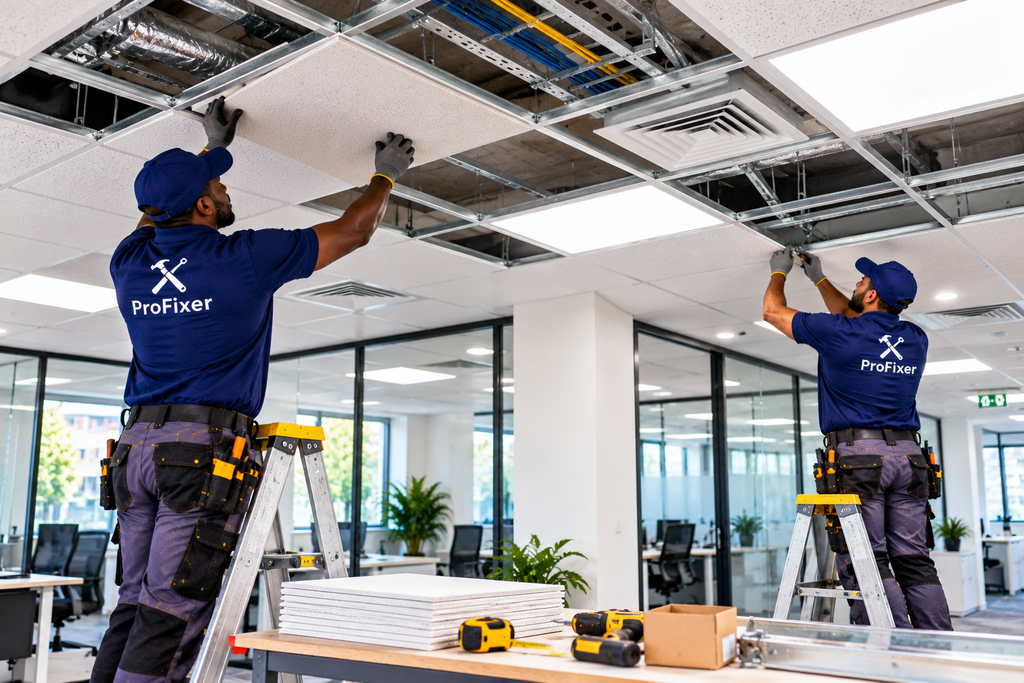
These systems allow easier access to electrical, networking and air-conditioning services.
Shop Ceilings
Retail spaces may use suspended ceilings, open ceilings or decorative bulkheads.
The ceiling design often needs to coordinate with lighting and signage.
Cornice Installation
Cornices create a finished junction between the ceiling and wall.
Professional cornice installers near me can fit new cornices during renovations, repairs or new construction.
Accurate cutting and alignment are especially important at internal and external corners.
Plaster Cornices
Plaster cornices can provide a traditional or decorative finish.
They are heavier and can require more careful installation than lightweight options.
Joints and corners should be filled and sanded so they blend into the moulding.
Polystyrene Cornices
Polystyrene cornices are lightweight and relatively easy to install.
They are available in many profiles and can be painted after installation.
Careful handling is important because the material can dent or mark.
Polyurethane Cornices
Polyurethane cornices can provide detailed profiles while remaining lighter than traditional plaster.
They are often used where a more decorative finish is required.
Decorative Cornices
Decorative cornices can range from simple stepped profiles to highly detailed mouldings.
The style should suit the proportions and architecture of the room.
Very large cornices can overwhelm rooms with low ceilings.
Modern Cornices
Modern interiors often use simpler cornice profiles.
Straight lines and minimal detailing can create a clean transition between the wall and ceiling.
Cornice Repairs
Cornices can crack, separate or become damaged during renovations.
Repairs may involve filling joints, replacing damaged sections or refixing loose mouldings.
Matching an older decorative profile can sometimes be challenging.
Cracked Cornice Repairs
Cracks may develop at corners or joints.
These should be repaired before repainting.
If the crack keeps returning, movement in the wall or ceiling may need further investigation.
Loose Cornice Repairs
Cornices can pull away from walls or ceilings where adhesive has failed.
Loose sections should be secured properly rather than simply filled with sealant.
Replacing Damaged Cornices
Where sections are badly damaged, replacing them may provide a better finish than repeated repairs.
The challenge is finding a matching profile where only part of the room is being replaced.
Removing Old Cornices
Old cornices may need to be removed during ceiling replacement or a room redesign.
Removal should be done carefully to minimise damage to the wall and ceiling surfaces.
Repair work may still be needed before the new finish is installed.
Cornices During Renovations
New cornices are often installed after ceiling and wall repairs are complete but before final painting.
This allows joints and corners to be filled and finished together.
Ceiling and Cornice Painting
Ceilings and cornices are usually painted after all repairs, sanding and joint finishing are complete.
A poor surface will remain visible even under fresh paint.
For professional finishing, compare painting contractors through ProFixer.
Preparing Ceilings for Painting
Preparation may involve:
- Filling
- Sanding
- Joint repairs
- Removing loose paint
- Priming stains
- Cleaning dust
Water stains may require suitable stain-blocking treatment before repainting.
Preparing Cornices for Painting
Cornice joints and fixing points should be filled and sanded where required.
Decorative mouldings may need extra care so detail is not lost under excessive filler or paint.
Ceiling Plastering
Some ceilings may require plaster finishing or repairs.
Plastering can help create a smooth continuous surface before painting.
For specialist work, compare plastering contractors through ProFixer.
Ceiling Lighting Preparation
Ceiling installation often needs to be coordinated with lighting.
Electrical cables and positions should be planned before the boards are fully closed.
For electrical work, compare electrical services through ProFixer.
Recessed Downlights
Downlights need accurately positioned openings.
The installer should also consider the space above the ceiling and any insulation or structural elements.
Electrical installation should be completed by an appropriately qualified contractor.
Pendant Lights
Pendant lights may require additional support depending on the fitting weight.
The mounting point should not rely only on unsupported ceiling board.
LED Strip Lighting in Bulkheads
LED lighting is often incorporated into recessed bulkheads.
The design should include suitable space for the lighting channel, wiring and power supply.
Ceiling Fans
Ceiling fans require secure structural support.
They should never be mounted only to a lightweight ceiling board.
The installer should identify a suitable fixing point above the ceiling.
Access Panels
Access panels may be required where plumbing, electrical equipment or valves are concealed above a ceiling.
Planning these access points can make future maintenance easier.
Ceiling Air Vents
Air-conditioning and ventilation outlets may need to pass through the ceiling.
Their positions should be coordinated before final installation.
Ceiling Repairs Around Light Fittings
Changing light fittings can expose old holes or damaged surfaces.
These areas may need patching and refinishing before the new fitting is installed.
Cornices Around Built-In Cupboards
Cornices and tall cupboards need careful coordination.
Where cupboards extend close to the ceiling, the cornice may stop at the unit or continue across it depending on the design.
For cupboard work, compare built-in cupboard installers through ProFixer.
Ceiling Work Around Kitchen Cabinets
Kitchen wall units and ceiling bulkheads often need accurate alignment.
Poor ceiling levels can make cabinets appear crooked even when they are installed correctly.
Ceiling Work Around Curtains
Curtain tracks and pelmets may interact with cornices or dropped ceiling sections.
Their positions should be planned early where recessed curtain tracks are required.
Ceiling and Cornice Work During Home Improvements
Ceiling and cornice upgrades can form part of broader interior improvements.
They may be combined with painting, flooring, new cupboards and lighting.
For wider projects, compare home improvement contractors through ProFixer.
Ceiling Renovation in Older Homes
Older properties may contain ceilings that have been repaired several times.
A contractor should assess whether further patching is worthwhile or whether replacement would produce a better long-term result.
Uneven Ceilings
Uneven ceilings may be caused by poor framing, settlement or previous repair work.
The best solution depends on the severity of the problem.
Minor imperfections may be corrected during finishing, while larger issues may require structural adjustment.
Ceiling Stains
Stains can come from roof leaks, plumbing or condensation.
The cause should be identified before repainting.
Simply covering the mark without addressing the source can allow the stain to return.
Mould on Ceilings
Mould may indicate condensation, poor ventilation or moisture ingress.
The underlying moisture problem should be addressed before cosmetic treatment.
Bathrooms and kitchens are particularly vulnerable where ventilation is inadequate.
Peeling Ceiling Paint
Paint may peel due to moisture, poor preparation or incompatible previous coatings.
Loose paint should be removed and the surface prepared before repainting.
Repair or Replace a Ceiling?
Repair is usually practical where damage is localised.
Replacement may be more appropriate where the ceiling is extensively sagging, badly cracked or affected by widespread water damage.
A contractor can inspect the ceiling and explain which approach is likely to provide the better result.
Repair or Replace Cornices?
Small cracks and loose joints can often be repaired.
Replacement may be better where large sections are broken or the homeowner wants a completely different style.
What Affects Ceiling Installation Costs?
The cost of hiring ceiling and cornice contractors depends on the ceiling size, height and system being installed.
Cost factors may include:
- Ceiling boards
- Framing
- Labour
- Joint finishing
- Bulkheads
- Insulation
- Lighting preparation
- Painting
High ceilings or complex designs usually require more labour.
What Affects Ceiling Repair Costs?
Repair costs depend on the cause and extent of the damage.
A small patch can be relatively simple, while sagging caused by failed framing may require significantly more work.
Water damage can also increase the scope if insulation or timber above the ceiling has been affected.
What Affects Cornice Installation Costs?
Cornice costs vary according to the material, profile and room perimeter.
Decorative plaster mouldings generally require more installation time than lightweight simple profiles.
Rooms with many corners can also take longer.
Supply and Installation or Labour Only?
Some contractors supply all ceiling and cornice materials.
Others provide installation only.
If you are purchasing materials yourself, confirm the correct quantities and specifications before ordering.
What Should a Ceiling and Cornice Quote Include?
A clear quotation should describe the full scope of work.
It may include ceiling boards, framing, cornices, joint treatment, repairs, sanding, waste removal and preparation for painting.
Ask whether painting and electrical work are included or quoted separately.
Questions to Ask Ceiling and Cornice Contractors
Before choosing a contractor, ask what ceiling system they recommend and whether existing framing needs repairs.
Also confirm whether the quotation includes cornices, joint finishing, sanding, waste disposal and preparation for painting.
For damaged ceilings, ask whether the contractor has identified the cause rather than only repairing the visible surface.
Compare Ceiling and Cornice Contractors Through ProFixer
Choosing ceiling and cornice contractors is easier when you compare the complete scope rather than the headline price.
One contractor may include framing, boards, cornices and final joint finishing, while another quote may cover labour only.
ProFixer allows you to post your project once and connect with suitable local professionals.
Upload photographs, provide approximate room dimensions and explain whether you need a new ceiling, repairs, cornices, bulkheads or complete replacement.
Compare contractors based on materials, preparation, installation method, finishing, expected timeline and total cost.
Get Free Ceiling and Cornice Quotes
Whether you need ceiling contractors near me, cornice installers near me, professional ceiling installation services or experienced ceiling repair contractors, ProFixer can help you connect with suitable local professionals.
Compare up to three no-obligation quotes from local ceiling and cornice contractors.
GET FREE CEILING & CORNICE QUOTES