
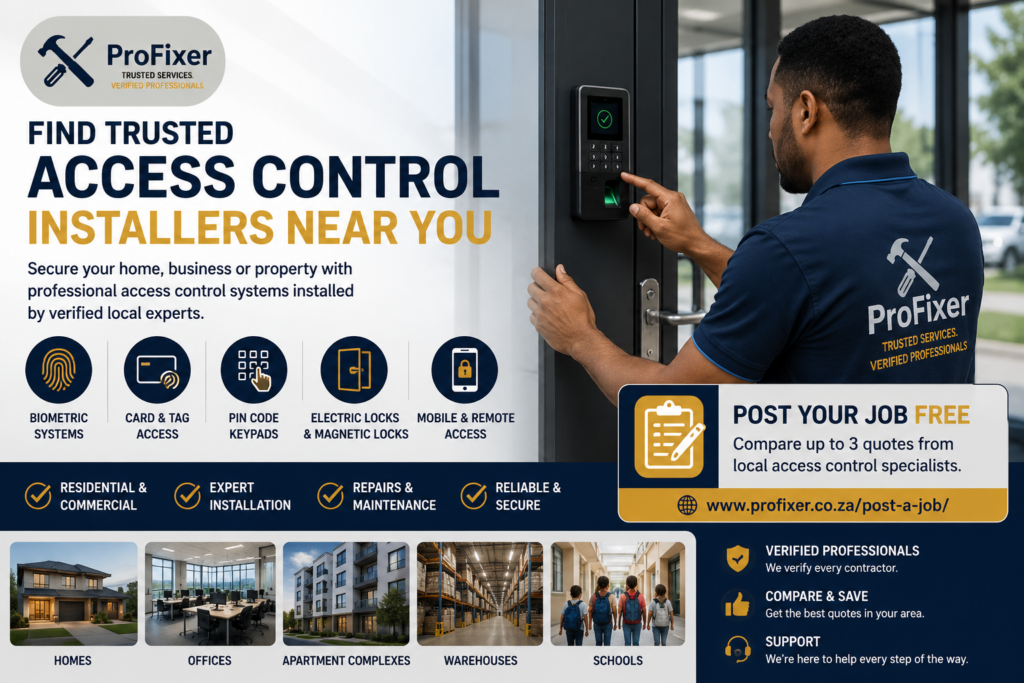
Find Trusted Access Control Installers Near You
Controlling who can enter your home, office, complex or commercial property is an important part of protecting people, equipment and valuable information. Professional access control installers can help you choose and install a system that provides secure, convenient and manageable access to your property.
Whether you need a simple keypad for one door, a biometric reader for an office, card access for multiple buildings or an integrated system for gates and turnstiles, ProFixer makes it easier to find local specialists. Post your access control job for free and compare up to three no-obligation quotes before deciding who to hire.
Table of Contents
Why Choose Professional Access Control Installers?
An access control system includes more than the reader mounted next to a door. It may also require electric locks, door controllers, power supplies, backup batteries, exit buttons, emergency release devices, software and network connections. These components must work together correctly for the system to remain secure and reliable.
Experienced access control installers assess the property before recommending equipment. They consider the type of door or gate, the number of users, how often the entrance is used and what should happen during a power failure or emergency.
A professional installation can help you:
- control who is allowed to enter specific areas
- remove access when employees, tenants or contractors leave
- reduce the number of physical keys in circulation
- record entry and exit activity where supported
- manage multiple doors from one system
- integrate access control with gates, intercoms and security systems
- improve convenience without compromising security
The installer should explain how the proposed system works, what equipment is included and how it can be expanded in the future.
Access Control Installers for Homes and Residential Properties
Residential access control can be used at houses, estates, apartment buildings, sectional-title complexes and rental properties. The right solution depends on the number of residents, visitors and entrances that need to be managed.
For a private home, an installer may recommend a keypad, smart lock, tag reader or video intercom for the main entrance. Gate access can also be linked to remote controls, mobile phones or an intercom system, allowing residents to identify visitors before granting entry.
At apartment buildings and complexes, access control may be required for:
- pedestrian entrances
- vehicle gates
- communal facilities
- parking areas
- refuse rooms
- storerooms
- staff entrances
- restricted service areas
Reliable access control installers can also advise property managers on managing lost tags, adding new residents and maintaining a clear record of authorised users.
Commercial Access Control Installers
Businesses often require more detailed control over who can access particular departments, buildings or secure rooms. A commercial system can assign different access rights to employees, cleaners, contractors, visitors and management.
Access control is commonly installed in:
- offices and business parks
- retail stores and shopping centres
- warehouses and distribution centres
- factories and workshops
- schools and training centres
- medical practices and healthcare facilities
- hotels and guesthouses
- residential complexes
- server rooms and data areas
Commercial access control installers may also integrate the system with CCTV, alarm systems, visitor management, turnstiles, boom gates and automatic gates. Integration can help security staff verify events and manage access from a central point.
Types of Access Control Systems
There are several ways to identify an authorised user. The most suitable option depends on the level of security required, the number of users, the environment and the available budget.
Card and Tag Access Systems
Card and tag systems allow users to present a programmed credential to a reader. They are widely used because cards and tags can usually be added or removed without changing the lock.
If a card is lost, the administrator can disable it and issue a replacement. This is often more practical than replacing locks when a physical key goes missing.
Biometric Access Control
Biometric systems use a physical characteristic such as a fingerprint or facial image to identify users. They can reduce the problem of cards being shared between employees, although correct positioning, enrolment and system management are important.
A professional installer should discuss the environment in which the reader will operate. Outdoor conditions, dust, high traffic and user requirements can affect which biometric technology is most suitable.
PIN Code Keypads
A keypad allows authorised users to enter a PIN to unlock a door or gate. Keypads can be suitable for homes, small offices, storerooms and staff entrances.
Codes should be changed when they are no longer secure. For higher-risk areas, a keypad may be combined with a card, tag or biometric reader.
Mobile and Remote Access
Some modern systems allow users or administrators to manage access through a mobile application or web-based platform. Depending on the equipment, this may allow remote door release, user management and access-event viewing.
Ask the installer whether the system requires internet access, a subscription or cloud storage. You should also understand what functions will remain available during an internet or power failure.
Intercom and Visitor Access
An intercom allows a resident, receptionist or security officer to communicate with a visitor before releasing the entrance. Audio and video intercoms can be integrated with pedestrian gates, vehicle gates and controlled doors.
For properties that already have gate automation, you can also compare quotes from local specialists through our gate motor installer service.
Doors and Entrances Access Control Installers Can Secure
Access control can be installed on many types of doors and entrances, but the locking equipment must suit the structure and the way it is used.
Installations may include:
- wooden doors
- aluminium doors
- glass doors
- steel security doors
- sliding doors
- pedestrian gates
- automatic vehicle gates
- boom gates
- turnstiles
- server cabinets and secure enclosures
The installer may recommend a magnetic lock, electric strike, motorised lock, drop bolt or another locking device. The door closer, hinges, frame and alignment must also be checked because a poorly closing door can cause repeated locking faults.
Controlled doors should still allow safe exit when required. Your installer should explain the emergency release arrangement and what happens during a fire alarm or power failure.
What Happens During an Access Control Installation?
A good installation normally begins with a site assessment. The contractor should inspect the doors, gates, available power, cable routes and network requirements before preparing a quotation.
The installation process may include:
- confirming which entrances need to be controlled
- identifying the number and type of users
- selecting appropriate readers and locks
- installing cabling, controllers and power supplies
- fitting readers, exit devices and door-release equipment
- programming access permissions
- testing normal entry and emergency operation
- training the property owner or system administrator
Before accepting the job, confirm whether the quote includes all locks, power supplies, batteries, cabling, software licences, programming and user training.
Access Control Repairs and Maintenance
Even a professionally installed system needs occasional maintenance. Doors move, locks wear, batteries age and electrical connections can become loose or damaged.
Common access control faults include:
- a card, tag or fingerprint not being recognised
- a door remaining locked after access is granted
- a magnetic lock not securing properly
- an exit button failing to release the door
- a reader showing no power
- doors being reported as open when they are closed
- users disappearing from the system
- software or communication problems
- backup batteries failing during a power cut
Professional access control installers should diagnose the cause before replacing parts. A reader fault may be caused by cabling, power, programming or controller communication rather than the reader itself.
Businesses and complexes with several controlled entrances may benefit from scheduled maintenance. Routine inspections can identify worn locks, damaged cables, weak batteries and misaligned doors before they cause a complete access failure.
What Affects the Cost of Access Control Installation?
There is no single price for access control because every property has different doors, security requirements and infrastructure. A one-door keypad system will usually be simpler than a networked system controlling several buildings.
The quotation may be affected by:
- the number of controlled doors or gates
- the type of card, biometric or keypad readers
- the type and condition of each door
- electric locking equipment
- cabling distances and access
- power supplies and backup batteries
- network and software requirements
- integration with CCTV, alarms or intercoms
- the number of users to be enrolled
- training and ongoing support
Ask for a written quotation that separates equipment, installation, programming and any recurring software or support costs. This makes it easier to compare contractors fairly.
Questions to Ask Access Control Installers
Before choosing a contractor, ask practical questions about both the installation and future support:
- Which type of system is suitable for my property?
- What equipment and brands are included?
- Can the system be expanded later?
- What happens during a power or internet failure?
- Are backup batteries included?
- Will the system integrate with my gate, CCTV or alarm?
- Who will program and enrol the users?
- Is administrator training included?
- What warranty applies to equipment and workmanship?
- Are software licences or subscriptions required?
- Do you provide repairs and ongoing maintenance?
The contractor should be able to explain the proposed system in clear language. Avoid accepting a quote that does not identify the equipment, installation work and support being offered.
Compare Access Control Installers Through ProFixer
Calling several companies, arranging site visits and comparing different systems can take time. ProFixer gives you a simpler starting point by allowing you to post one job and receive responses from local contractors.
When posting your request, include:
- your town, suburb or area
- the type of property
- the number of doors or gates
- the type of access you are considering
- whether an existing system needs repair or replacement
- any required CCTV, intercom or gate integration
- photographs of the doors or entrances where possible
Clear information helps access control installers understand the job and provide more relevant advice. You can then compare the proposed equipment, scope of work, availability, warranty and price before choosing a contractor.
Post Your Access Control Job Free
Whether you need a keypad for one entrance, biometric access for employees or a complete multi-door system, ProFixer can help you connect with local specialists.
Post your access control job free and compare up to three no-obligation quotes from local contractors. You can also read more about how ProFixer works or browse our service categories for other property and security services.
Find access control installers near you and take the next step towards safer, more convenient property access.