
Find Trusted Boundary Wall Contractors Near You
A well-built boundary wall can improve security, privacy, appearance and property definition. Whether you are building a new wall, extending an existing one, repairing cracks or upgrading your perimeter with gates, fencing or electric fencing, the quality of the foundations, brickwork, plastering and finishes will affect how well the wall performs over time.
Professional boundary wall contractors can help with new wall construction, repairs, extensions, rebuilding damaged sections and preparing walls for security upgrades. A good contractor should assess the ground conditions, wall height, existing structures, drainage and access requirements before work begins.
ProFixer makes it easier to connect with suitable local professionals. Post your boundary wall job free, upload photographs where possible, provide the approximate wall length and height, and compare up to three no-obligation quotes from contractors serving your area.
Table of Contents
Why Hire Professional Boundary Wall Contractors?
Boundary walls may look simple, but they depend on several construction elements working together properly. Weak foundations, poor brickwork, inadequate reinforcement or poor drainage can lead to cracking, leaning or premature failure.
Professional boundary wall contractors can help ensure that the wall is correctly planned and built for the site.
They may assist with:
- New boundary wall construction
- Brick boundary walls
- Block boundary walls
- Plastered walls
- Wall extensions
- Raising existing walls
- Boundary wall repairs
- Cracked wall repairs
- Leaning wall repairs
- Rebuilding damaged sections
- Gate pillars
- Pedestrian gate openings
- Driveway entrances
- Security upgrades
- Plastering and painting
A properly constructed wall should provide stability, security and a clean finished appearance.
How to Find Boundary Wall Contractors Near Me
Searching for boundary wall contractors near me can give you many options, but contractors may quote very different specifications.
When requesting quotes, provide:
- Your suburb, town or city
- Approximate wall length
- Approximate wall height
- Photographs of the boundary
- Whether there is an existing wall
- Whether demolition is required
- Preferred wall finish
- Number of gate openings
- Whether pillars are required
- Whether electric fencing will be added
- Whether plastering and painting are required
- Desired project timeframe
For larger projects, a site visit is usually necessary before a final quotation is provided.
New Boundary Wall Construction
A new boundary wall construction project normally involves more than laying bricks or blocks.
The work may include:
- Site measurement
- Boundary setting-out
- Excavation
- Foundations
- Reinforcement
- Brick or block construction
- Pillars
- Gate openings
- Coping
- Plastering
- Painting
- Drainage considerations
- Security preparation
The contractor should consider the soil, wall height and surrounding conditions before construction begins.
Brick Boundary Walls
Brick walls are commonly used for residential and commercial boundaries.
They can be:
- Face-brick
- Plastered
- Painted
- Combined with steel fencing
- Built between masonry pillars
Brickwork should remain straight, level and properly bonded.
For specialist masonry work, you can also compare bricklaying contractors through ProFixer.
Block Boundary Walls
Concrete blocks can be used for boundary walls where speed and structural strength are important.
Block walls may later be:
- Plastered
- Painted
- Clad
- Combined with steelwork
The foundation and reinforcement should be appropriate for the wall height and site conditions.
Plastered Boundary Walls
Plastering provides a smooth finish and can help protect masonry from weather exposure.
A plastered wall may include:
- Scratch coat
- Finishing coat
- Corner detailing
- Coping
- Waterproof coatings
For larger plastering projects, compare suitable plastering contractors through ProFixer.
Painted Boundary Walls
Painting can improve appearance and add an extra layer of weather protection.
Good preparation may include:
- Cleaning
- Repairing cracks
- Removing loose paint
- Priming
- Sealing
- Applying exterior paint
For larger finishing projects, you can compare painting contractors through ProFixer.
Boundary Wall Foundations
Foundations are critical because the wall depends on them for stability.
Poor foundations can result in:
- Cracking
- Leaning
- Settlement
- Wall movement
Foundation design may depend on:
- Wall height
- Soil conditions
- Ground slope
- Wall length
- Gate openings
- Nearby trees
- Drainage
For foundation work, you may also need experienced concrete contractors.
Reinforced Boundary Walls
Some walls require reinforcement to improve strength.
Reinforcement may include:
- Reinforcing steel
- Concrete columns
- Bond beams
- Reinforced footings
- Pillar reinforcement
The correct design depends on the wall size and site conditions.
Boundary Wall Pillars
Pillars can provide additional support and improve appearance.
They may also be used for:
- Gates
- Intercoms
- Lights
- Access control
- Electric fencing brackets
Pillars should be properly tied into the wall or foundation system.
Gate Pillars
Gate pillars carry additional loads from gates, hinges and sometimes automation equipment.
They should be designed to support:
- Swing gates
- Sliding gates
- Pedestrian gates
- Security gates
Where gates are included, coordination with steel gate contractors is important.
Driveway Gate Openings
A driveway gate opening needs to be measured carefully.
The contractor should consider:
- Vehicle width
- Turning space
- Gate type
- Pillar positions
- Motor position
- Ground levels
- Drainage
Building the pillars before the gate design is finalised can create avoidable problems.
Pedestrian Gate Openings
Pedestrian gates require suitable opening width and secure fixing points.
The opening should allow for:
- Gate frame
- Hinges
- Locking system
- Access control if required
The finished wall should be straight and plumb around the opening.
Boundary Wall Extensions
An existing wall can sometimes be extended in length.
This may require:
- New foundations
- Matching brickwork
- Matching plaster
- New pillars
- New coping
- Repainting
The new section should be integrated carefully with the existing wall.
Raising Existing Boundary Walls
Homeowners may want to increase the wall height for privacy or security.
Before raising a wall, the contractor should assess whether the existing foundation and wall can safely support the extra load.
Options may include:
- Additional masonry
- Palisade fencing above the wall
- Steel panels
- Electric fencing
In some cases, a lighter steel security solution may be more appropriate than adding more masonry.
Boundary Wall Repairs
Professional boundary wall repairs may include:
- Crack repairs
- Repointing
- Rebuilding sections
- Plaster repairs
- Reinforcing weak areas
- Straightening sections
- Replacing coping
- Painting
The cause of the damage should be identified before repairs are carried out.
Cracked Boundary Wall Repairs
Cracks can develop because of:
- Foundation movement
- Soil settlement
- Tree roots
- Poor construction
- Water damage
- Thermal movement
Small cracks may be cosmetic, while larger or widening cracks may indicate structural movement.
The contractor should inspect the wall before simply filling the crack.
Leaning Boundary Walls
A leaning wall may indicate serious foundation or structural problems.
Possible causes include:
- Weak foundations
- Soil movement
- Vehicle impact
- Water pressure
- Tree roots
- Poor reinforcement
A leaning wall should be assessed carefully before repair work begins.
Collapsed Boundary Wall Repairs
Walls can collapse because of:
- Storm damage
- Vehicle impact
- Foundation failure
- Poor construction
- Excessive water pressure
- Severe cracking
Damaged sections may need to be demolished and rebuilt.
Vehicle Impact Damage
Boundary walls near driveways or roads may be damaged by vehicles.
Repairs may involve:
- Demolition
- Foundation repairs
- Brickwork
- Reinforcement
- Pillar replacement
- Plastering
- Painting
Where a gate is also damaged, steelwork repairs may be needed.
Storm-Damaged Boundary Walls
Severe weather can damage unstable walls.
Signs may include:
- Cracking
- Loose coping
- Leaning sections
- Collapsed sections
- Water damage
Repairs should restore both appearance and structural stability.
Water Damage to Boundary Walls
Persistent moisture can weaken finishes and accelerate deterioration.
Common signs include:
- Peeling paint
- Efflorescence
- Damp patches
- Crumbling plaster
- Moss growth
The source of moisture should be addressed before cosmetic repairs are completed.
Drainage Around Boundary Walls
Poor drainage can contribute to wall movement and moisture problems.
Contractors should consider:
- Ground levels
- Surface runoff
- Nearby paving
- Downpipes
- Soil conditions
Water should not be allowed to collect against the base of the wall.
Boundary Walls on Sloping Ground
Sloping properties require more careful setting-out.
The wall may be:
- Stepped
- Terraced
- Built with retaining sections
The contractor should consider foundation levels and drainage carefully.
Retaining Sections
Some boundary walls also retain soil.
These sections require more structural consideration than a normal freestanding wall.
They may need:
- Stronger foundations
- Reinforcement
- Drainage
- Weep holes
- Engineering input
A wall that retains soil should not be treated as a standard decorative boundary wall.
Boundary Walls and Steel Gates
Boundary walls often include one or more steel gates.
The wall and gate should be planned together so that:
- Pillars are correctly positioned
- Gate openings are accurate
- Hinges have strong fixing points
- Sliding gates have enough run-back space
- Automation can be added later
For gate fabrication and installation, compare steel gate contractors through ProFixer.
Boundary Walls and Palisade Fencing
Some properties combine masonry walls with palisade fencing.
This can provide:
- Security
- Visibility
- Reduced masonry costs
- A lighter appearance
For these projects, you can also compare palisade fencing contractors through ProFixer.
Boundary Walls and Electric Fencing
Electric fencing is often installed above boundary walls.
The wall should provide suitable support for:
- Brackets
- Straining posts
- Earth connections
- Cable routing
For the electrical security system itself, compare electric fence installation specialists through ProFixer.
Boundary Walls and CCTV
A perimeter wall can form part of a broader security system.
CCTV cameras may be positioned to monitor:
- Gates
- Driveways
- Wall corners
- Side passages
- Pedestrian entrances
Camera positions should be planned with the wall height and surrounding vegetation in mind.
Boundary Walls and Access Control
Where walls include controlled gates, access control systems may be added.
Options may include:
- Keypads
- Tags
- Card readers
- Intercoms
- Remote controls
These systems should be planned alongside gate and pillar construction where possible.
Boundary Wall Coping
Coping protects the top of the wall from water penetration.
Options may include:
- Precast coping
- Brick-on-edge coping
- Concrete coping
- Decorative caps
Proper coping can help reduce water damage.
Decorative Boundary Walls
Boundary walls can also contribute to the appearance of a property.
Decorative options may include:
- Face brick
- Textured plaster
- Stone cladding
- Feature pillars
- Steel inserts
- Palisade panels
The design should still prioritise strength and drainage.
Boundary Walls for Residential Properties
Residential walls may be used for:
- Privacy
- Security
- Noise reduction
- Property separation
- Garden protection
The wall height and finish should suit the house and surrounding properties.
Boundary Walls for Businesses
Commercial properties may need longer, stronger walls.
Applications include:
- Offices
- Retail properties
- Workshops
- Warehouses
- Parking areas
Commercial walls may also need large vehicle entrances and security infrastructure.
Boundary Walls for Industrial Sites
Industrial boundaries may require:
- Higher walls
- Reinforced pillars
- Vehicle gates
- Electric fencing
- CCTV
- Access control
The wall should be designed for the operational requirements of the site.
Boundary Walls for Estates and Complexes
Residential estates may use a combination of:
- Masonry walls
- Palisade fencing
- Steel gates
- Guardhouses
- Electric fencing
- CCTV
A coordinated perimeter design can improve both security and appearance.
Boundary Walls for Rental Properties
Landlords may prefer durable, low-maintenance boundary solutions.
Practical considerations include:
- Strong construction
- Easy repair
- Neutral finishes
- Secure gates
- Durable paint
Boundary Wall Renovations
Older walls can sometimes be upgraded instead of replaced.
Renovation work may include:
- Crack repairs
- Replastering
- Repainting
- Raising the wall
- Adding pillars
- Installing steel fencing
- Replacing gates
The contractor should assess whether the existing wall is structurally suitable for upgrading.
Rebuilding Old Boundary Walls
Very old walls may become uneconomical to repair.
Replacement may be the better option where there is:
- Severe cracking
- Extensive leaning
- Major foundation failure
- Widespread water damage
- Poor original construction
The new wall can then be built to a more suitable standard.
Removing Existing Boundary Walls
Demolition may be required before a new wall is built.
This may include:
- Breaking masonry
- Removing rubble
- Removing foundations
- Removing old gates
- Site clearing
Ask whether rubble removal and disposal are included in the quotation.
Boundary Wall Plaster Repairs
Damaged plaster can make an otherwise sound wall look neglected.
Repairs may involve:
- Removing loose plaster
- Cleaning the surface
- Filling cracks
- Replastering
- Sealing
- Repainting
For larger areas, compare plastering contractors.
Boundary Wall Painting
After repairs or plastering, painting can restore the appearance of the wall.
Exterior paint should be suitable for:
- Rain
- Sun
- Temperature changes
- Masonry surfaces
Proper preparation is more important than simply applying a fresh coat.
Steelwork on Boundary Walls
Boundary walls may require steelwork for:
- Gate frames
- Fence panels
- Brackets
- Handrails
- Security structures
For custom steelwork, compare welding and steel-fabrication contractors through ProFixer.
Boundary Wall Security Upgrades
A wall can be upgraded without completely rebuilding it.
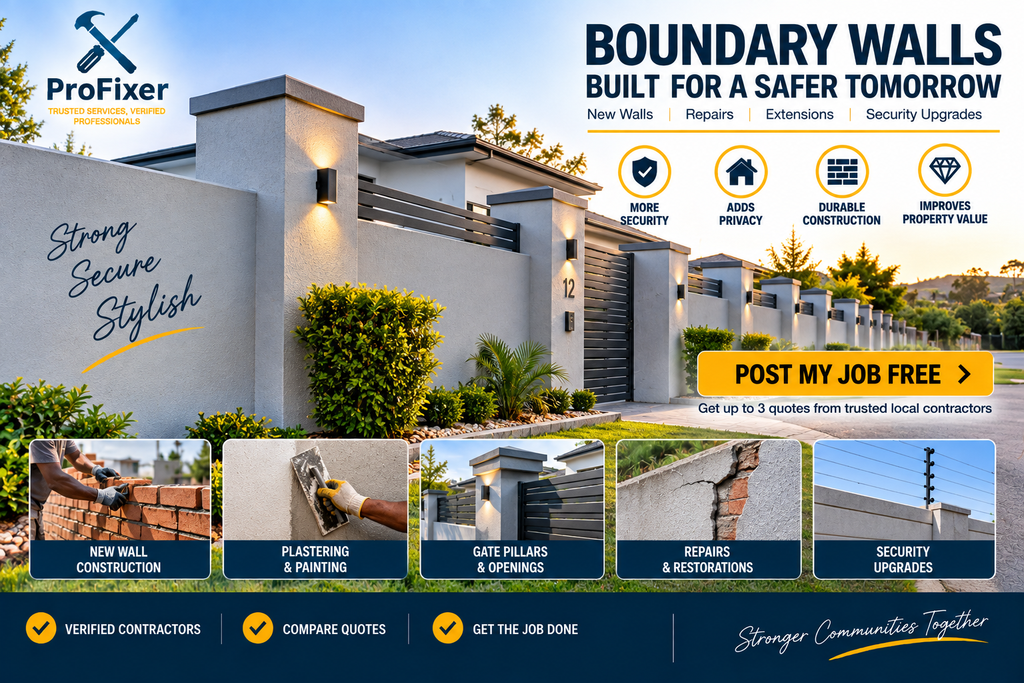
Security upgrades may include:
- Raising the wall
- Adding palisade fencing
- Adding electric fencing
- Installing stronger gates
- Improving lighting
- Adding CCTV
The best option depends on the current wall condition and security requirements.
What Affects Boundary Wall Construction Costs?
The cost of boundary wall construction depends on the wall size, materials, foundations and finishes.
Pricing may be affected by:
- Total wall length
- Wall height
- Brick or block type
- Foundation size
- Reinforcement
- Pillars
- Gate openings
- Plastering
- Coping
- Painting
- Demolition
- Ground conditions
- Site access
- Sloping ground
- Drainage requirements
Long straight walls may cost less per metre than walls with many corners, pillars and gates.
What Affects Boundary Wall Repair Costs?
Repair costs depend on the cause and extent of the damage.
Factors may include:
- Crack size
- Leaning
- Foundation damage
- Plaster damage
- Vehicle impact
- Water damage
- Rebuilding required
- Painting
- Access
A small plaster crack is very different from a structurally unstable wall.
What Should a Boundary Wall Quote Include?
A clear quotation should explain the full scope.
It may include:
- Wall length
- Wall height
- Brick or block type
- Foundation specification
- Reinforcement
- Pillars
- Gate openings
- Coping
- Plaster
- Paint
- Demolition
- Rubble removal
- Labour
- Materials
- Estimated duration
- Warranty
- VAT status
Ask contractors to identify exclusions clearly.
Questions to Ask Boundary Wall Contractors
Before choosing a contractor, ask:
- What foundation do you recommend?
- What bricks or blocks will be used?
- Will reinforcement be included?
- How high will the wall be?
- Are pillars included?
- Are gate openings included?
- Is plastering included?
- Is painting included?
- Is coping included?
- Is rubble removal included?
- How will drainage be handled?
- Can electric fencing be added later?
- How long will the work take?
- What warranty is provided?
- What could increase the final cost?
Clear answers make it easier to compare quotations properly.
Compare Boundary Wall Contractors Through ProFixer
Finding reliable boundary wall contractors can be difficult because quotations may use different wall thicknesses, foundations, brick types, reinforcement and finishes.
ProFixer allows you to post one job and connect with local contractors interested in your project. Provide the approximate wall length, height, photographs and information about gates or security upgrades so contractors can understand the work required.
Compare quotes based on:
- Foundation specification
- Wall thickness
- Brick or block quality
- Reinforcement
- Pillars
- Finishes
- Gate preparation
- Drainage
- Warranty
- Total price
A lower quotation may exclude important items such as foundations, plastering, coping or rubble removal.
Post Your Boundary Wall Job Free
Whether you need boundary wall builders for a new wall, professional boundary wall construction, repairs to cracked or leaning walls, wall extensions or a complete perimeter upgrade, ProFixer can help you connect with suitable local contractors.
Post your boundary wall job free and compare up to three no-obligation quotes from contractors serving your area.
POST MY BOUNDARY WALL JOB FREE