
Find Trusted Borehole Drilling Contractors Near You
A borehole can provide a valuable independent water source for homes, farms, businesses and irrigation systems. However, successful borehole installation depends on more than simply drilling a hole into the ground. The site needs to be assessed, the borehole needs to be drilled and cased correctly, water yield needs to be tested and the right pump and storage system must be selected.
Professional borehole drilling contractors can manage the process from initial site assessment through drilling, casing, testing and pump installation. They can also help with existing boreholes that have low pressure, poor yield, damaged pumps or electrical problems.
ProFixer makes it easier to connect with suitable local specialists. Post your borehole job free, provide the location and intended water use, and compare up to three no-obligation quotes from contractors serving your area.
Table of Contents
Why Hire Professional Borehole Drilling Contractors?
Borehole drilling requires specialised equipment and experience.
The contractor needs to understand ground conditions, select appropriate drilling equipment and decide how the borehole should be cased and developed.
A poorly constructed borehole can suffer from problems such as collapsing walls, sand entering the water, low yield or damage to the pump.
Experienced borehole drilling contractors can assess these risks and recommend a suitable drilling and installation approach.
How to Find Borehole Drilling Near Me
When searching for borehole drilling near me, provide contractors with as much information as possible.
Useful details include the property location, intended water use, approximate daily water requirement and whether there are existing boreholes nearby.
For farms or larger properties, it can also help to explain whether the water will be used for irrigation, livestock, buildings or storage tanks.
Contractors may need to visit the site before providing a final quotation.
Borehole Site Assessment
The first stage is usually to assess the property.
The contractor may consider access for drilling equipment, surrounding buildings, power lines, underground services and possible drilling locations.
The site also needs enough working space for the drilling rig and support vehicles.
Geological Assessment
Ground conditions can vary significantly between properties.
Rock type, soil layers and underground fractures can affect drilling depth and the likelihood of finding usable groundwater.
Some projects may involve geological information or specialist surveys before drilling begins.
Borehole Siting
Choosing the drilling position is important.
The selected location should consider both the likelihood of finding water and practical installation requirements.
The borehole should also be positioned so it can be accessed later for pump removal, testing or maintenance.
Borehole Surveying
Some contractors use geophysical surveying equipment to help identify underground formations that may contain groundwater.
A survey can help guide drilling decisions, but it cannot guarantee the exact quantity or quality of water that will be found.
Contractors should explain what the survey can and cannot determine.
Borehole Drilling
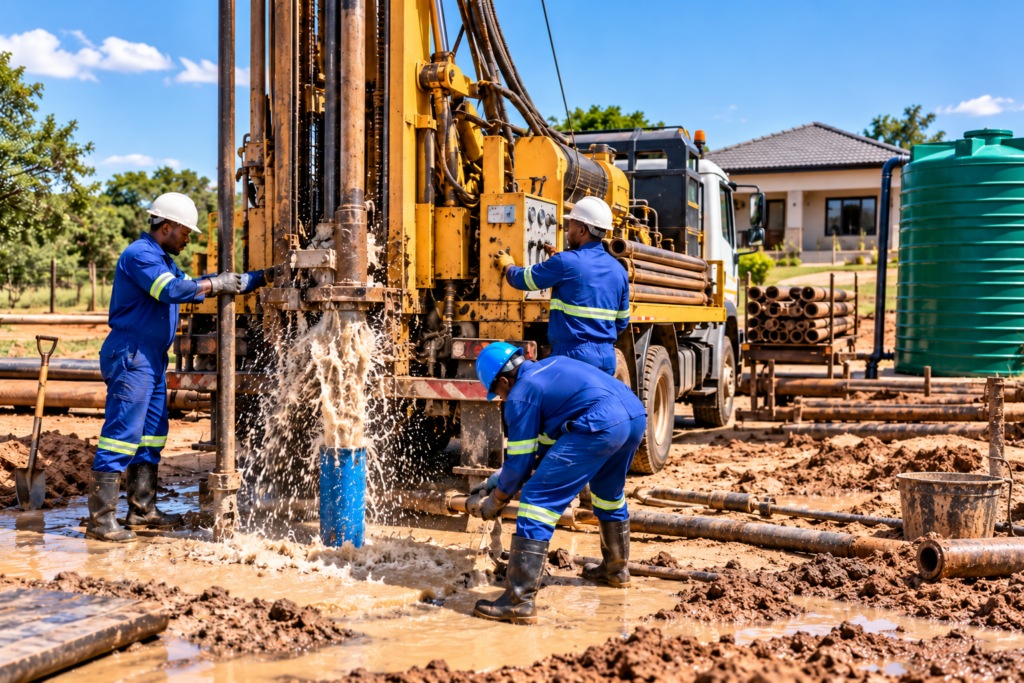
Once the drilling location has been selected, the contractor brings a drilling rig onto the property.
Different drilling methods may be used depending on the ground conditions.
The borehole is normally drilled progressively until a suitable water-bearing formation is reached or the planned drilling depth is achieved.
Borehole Drilling Depth
There is no single standard borehole depth that works for every property.
Some boreholes reach usable groundwater relatively quickly, while others need to be drilled much deeper.
Depth depends on the geology and groundwater conditions at the specific location.
When comparing quotes, ask how drilling depth is charged and what happens if additional drilling is required.
Borehole Diameter
The borehole needs enough diameter for casing, pump equipment and water movement.
The size may vary depending on the planned system and drilling method.
The contractor should explain the proposed borehole diameter before drilling begins.
Borehole Casing
Casing helps support the borehole and prevent loose material from collapsing into the hole.
Different casing materials and diameters may be used depending on ground conditions.
Good casing installation also helps protect the pump and maintain the borehole structure.
Borehole Screen Installation
In some formations, screen sections may be installed to allow groundwater to enter while helping limit sand and other material.
The correct screen type and position depend on the geological conditions encountered during drilling.
Borehole Gravel Pack
Some borehole designs use gravel around the screen.
This can help filter material and support the surrounding formation.
The exact construction method should suit the site conditions.
Borehole Development
After drilling, the borehole may need to be developed.
Development removes loose drilling material and helps improve water movement into the borehole.
This process may involve pumping, air lifting or other methods.
A properly developed borehole can provide cleaner water and more reliable yield.
Borehole Flushing
Newly drilled boreholes may initially produce cloudy or dirty water.
Flushing helps remove sediment and drilling residue.
The contractor should explain when the water is ready for testing or normal use.
Borehole Yield Testing
Yield testing helps determine how much water the borehole can produce.
This is important before selecting a pump.
A pump that draws water faster than the borehole can recover may run the borehole down and potentially damage equipment.
Pump Testing
A controlled pumping test may be used to measure how the water level changes while pumping.
The contractor can use this information to estimate a suitable pumping rate.
Longer tests may provide a better understanding of borehole performance.
Static Water Level
The static water level is the water level in the borehole when pumping is not taking place.
This measurement helps with pump design and installation depth.
Dynamic Water Level
The dynamic water level is the level reached while the borehole is being pumped.
It may be significantly lower than the static level.
Pump installation should consider both levels.
Borehole Recovery Rate
The recovery rate describes how quickly water returns after pumping.
This is important for deciding whether the borehole can support continuous use or should pump into storage over time.
Borehole Water Testing
Water quality should be tested before it is used for drinking.
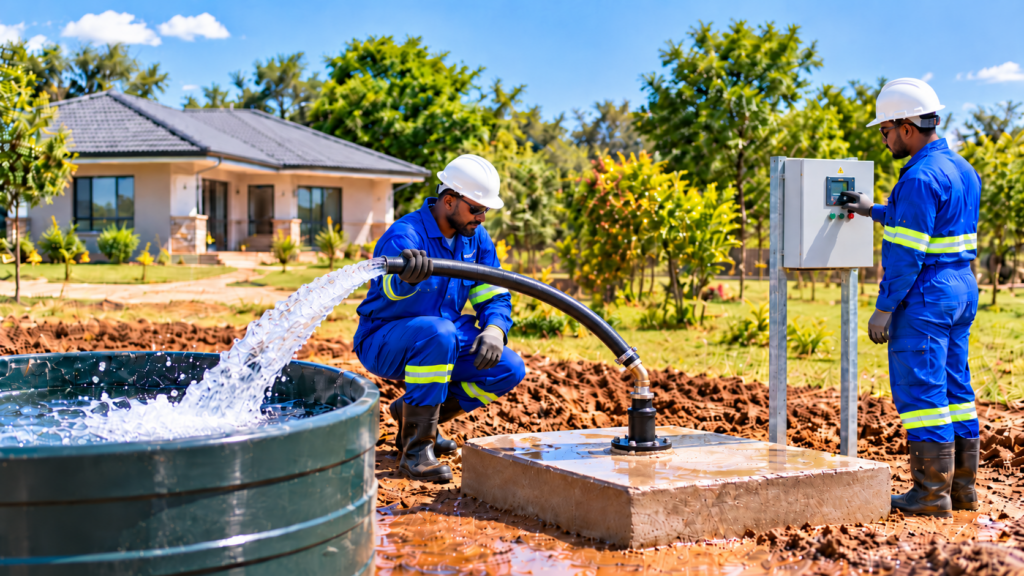
Clear-looking water is not necessarily safe.
Testing can identify issues such as excessive minerals, bacteria or other contaminants.
Treatment requirements depend on the intended use of the water.
Borehole Water for Household Use
A borehole can supply water for toilets, laundry, cleaning, gardens and, where properly tested and treated, drinking.
The system should be designed around the household’s expected demand.
Storage tanks can help reduce pressure on the borehole during peak usage periods.
For household plumbing connections, compare plumbing services through ProFixer.
Borehole Water for Irrigation
Boreholes are commonly used for gardens, landscaping and agricultural irrigation.
The required flow can be much higher than normal household demand.
The pump, pipework and irrigation zones should therefore be designed together.
For irrigation projects, compare irrigation-system installers through ProFixer.
Borehole Water for Farms
Farm boreholes may supply irrigation, livestock, worker accommodation or storage tanks.
Daily demand should be calculated carefully before the pump is selected.
A farm may benefit from pumping slowly into a large tank rather than trying to meet peak demand directly from the borehole.
Borehole Water for Livestock
Livestock water demand depends on the number and type of animals.
Storage is particularly useful because it provides a reserve if the pump needs maintenance.
Water quality should also be suitable for the intended livestock use.
Boreholes for Businesses
Commercial properties may use borehole water for cleaning, gardens, toilets or process requirements.
The system should be designed around expected demand and any water-quality requirements.
Boreholes for Schools and Community Facilities
Larger facilities may need substantial storage because demand can change significantly throughout the day.
Pump controls and tank levels become particularly important.
Complete Borehole Installation
A complete borehole installation can include much more than drilling.
It may involve:
- Drilling
- Casing
- Borehole development
- Yield testing
- Water testing
- Submersible pump
- Pump cable
- Rising main
- Control equipment
- Storage tanks
- Pressure pump
- Plumbing connections
Ask contractors to specify exactly what is included in the quotation.
Borehole Pump Installation
Most deep boreholes use submersible pumps.
The pump is installed below the water level and pushes water to the surface.
Correct pump selection depends on the borehole yield, pumping depth, pipe size and required pressure.
Professional borehole pump installation should be based on these measurements rather than simply choosing the largest available pump.
Submersible Borehole Pumps
Submersible pumps operate inside the borehole.
They are designed to lift water from depth and can supply tanks or pressure systems.
The pump should not be installed too close to the bottom where sediment may be drawn in.
Selecting the Right Borehole Pump
Pump selection should consider:
- Borehole depth
- Dynamic water level
- Borehole yield
- Required flow
- Pipe length
- Elevation
- Required pressure
Oversizing a pump can create as many problems as undersizing it.
Borehole Pump Depth
The pump should be installed deep enough to remain submerged during pumping but should not normally sit directly on the borehole bottom.
The contractor should use the measured water levels when deciding installation depth.
Borehole Rising Main
The rising main carries water from the pump to the surface.
Pipe size affects pressure loss and overall pump performance.
The material should be suitable for the pump depth and operating pressure.
Borehole Pump Cable
Submersible pumps require electrical cable running down the borehole.
Cable size depends on the motor and installation length.
Connections need to be properly sealed against water.
Borehole Electrical Connections
Pump installations may require control panels, breakers, isolators and protection equipment.
Electrical work should be completed safely by appropriately qualified contractors.
For related work, compare electrical services through ProFixer.
Borehole Pump Control Panel
A control panel can provide protection and automatic operation.
Depending on the system, it may include overload protection, dry-run protection and level controls.
Dry-Run Protection
A borehole pump can be damaged if it operates without sufficient water.
Dry-run protection can switch the pump off when conditions indicate the borehole has been pumped down.
This is especially important for low-yield boreholes.
Borehole Pressure Systems
Where water is supplied directly to taps or irrigation, a pressure system may be required.
This can include a pressure pump, controller or pressure vessel.
The system should maintain usable pressure while preventing excessive pump cycling.
Pressure Vessels
A pressure vessel stores water under pressure and can reduce how often a pump needs to start.
This can help protect equipment and provide smoother water delivery.
The vessel size should suit the system.
Borehole Storage Tanks
Storage tanks are often one of the most useful parts of a borehole system.
Instead of demanding large amounts of water directly from the borehole, the pump can fill a tank gradually.
Water can then be supplied from the tank when needed.
JoJo-Style Water Tanks
Above-ground plastic storage tanks are widely used in South African water systems.
Tank size should be selected based on water availability and expected consumption.
The tank installation should include a stable base and suitable overflow arrangements.
Borehole Tank Level Controls
Float switches or electronic level controls can automatically start and stop the borehole pump.
This prevents the tank from overflowing and reduces the need for manual operation.
Borehole Booster Pumps
A booster pump can supply water from the storage tank to the house or irrigation system.
This allows the borehole pump and distribution pump to operate independently.
Borehole Plumbing Connections
Pipework connects the borehole to tanks, pumps, irrigation and household systems.
The layout should include isolation valves and accessible connections for maintenance.
For plumbing work, compare plumbing services through ProFixer.
Borehole Filtration
Borehole water may contain sediment or minerals that need filtration.
Common systems may include sediment filters and specialist treatment depending on water-test results.
The treatment system should be selected based on actual water quality.
Borehole Water Treatment
Water treatment can vary significantly.
Depending on test results, treatment may be needed for bacteria, iron, hardness or other issues.
A contractor should avoid recommending expensive treatment equipment without knowing the water condition.
Borehole Water for Drinking
Water intended for drinking should be appropriately tested.
Treatment may be necessary even if the water appears clean.
Testing should be repeated periodically where drinking-water quality is important.
Borehole Irrigation Systems
A borehole can feed sprinklers, drip irrigation or other systems.
The irrigation system should be matched to the available borehole flow.
Where demand is higher than borehole yield, storage tanks can help balance supply.
For garden and agricultural irrigation, compare irrigation-system installers through ProFixer.
Borehole Systems for Landscaping
Landscaped properties may use borehole water for lawns, trees and planting beds.
A well-designed irrigation system can direct water where it is needed rather than relying on manual watering.
For broader garden projects, compare landscaping contractors through ProFixer.
Borehole Drip Irrigation
Drip irrigation uses water slowly and directly around plant roots.
This can make efficient use of limited borehole yield.
Filtration is important because small drip emitters can block easily.
Borehole Sprinkler Systems
Sprinklers usually require higher flow and pressure than drip irrigation.
The irrigation system may therefore need to operate in zones.
The available borehole yield should be confirmed before the system is designed.
Borehole Maintenance
Boreholes can operate for many years, but pumps and controls still require maintenance.
Regular checks can help identify declining pressure or unusual pump behaviour before a complete failure occurs.
Borehole Pump Maintenance
Pump maintenance may involve checking:
- Current draw
- Pressure
- Flow
- Control equipment
- Cables
- Non-return valves
If the pump is removed, it can also be inspected for wear or sediment damage.
Borehole Cleaning
Sediment or mineral deposits may build up over time.
In some cases, borehole cleaning or rehabilitation can improve performance.
The correct approach depends on the cause of the problem.
Borehole Rehabilitation
Older boreholes may lose yield because of sediment, scaling or blocked screens.
Rehabilitation techniques can sometimes improve water entry without drilling a completely new borehole.
A contractor should assess the condition first.
Low-Yield Boreholes
A borehole that produces less water than expected may still be usable.
Instead of pumping continuously at a high rate, the system can pump slowly into storage.
This allows the borehole time to recover.
Borehole Running Dry
If water supply stops during pumping, possible causes include low yield, falling groundwater levels or a pump installed too high.
The system should be investigated rather than repeatedly restarting the pump.
Borehole Pump Not Working
A pump that does not run may have an electrical, control or mechanical fault.
Possible causes include:
- Tripped breaker
- Faulty controller
- Damaged cable
- Failed motor
- Low-water protection
- Pump blockage
Electrical tests can help identify whether the fault is above or below ground.
Borehole Pump Running but No Water
If the pump operates but no water reaches the surface, the problem could involve a damaged pipe, failed non-return valve, low water level or worn pump.
The contractor may need to remove the pump for inspection.
Low Borehole Pressure
Low pressure can be caused by pump wear, pipe leaks, blocked filters or incorrect pressure settings.
The contractor should check both the borehole side and the distribution system.
Borehole Pump Cycling Frequently
A pump that switches on and off repeatedly may have a pressure-control or pressure-vessel problem.
Frequent cycling can shorten pump life.
The cause should be corrected rather than ignored.
Sand in Borehole Water
Sand can damage pumps, valves and irrigation equipment.
Possible causes include borehole construction problems, damaged casing or changes in the surrounding formation.
The borehole should be assessed before installing additional pumps.
Cloudy Borehole Water
Cloudy water may indicate fine sediment or other water-quality issues.
If the problem continues after flushing, further testing may be required.
Borehole Water Smell
Unusual odours can be caused by naturally occurring minerals, bacteria or other water-quality issues.
A water test can help determine the correct treatment approach.
Borehole Pump Replacement
Submersible pumps eventually wear out.
Replacing the pump usually requires pulling the existing pump, pipe and cable from the borehole.
The contractor should inspect the removed equipment before recommending replacement components.
Borehole Motor Replacement
Some pump failures involve the motor rather than the hydraulic pump section.
Depending on the pump type and condition, replacement or repair may be possible.
Borehole Pipe Repairs
Rising mains can split or leak.
A leak inside the borehole can reduce surface flow while the pump still appears to be operating.
Pump removal may be necessary to access the damaged section.
Borehole Cable Repairs
Cable damage can cause intermittent operation or electrical faults.
Submersible cable joints must be properly sealed.
Borehole Control Faults
Control panels, pressure switches and float switches can fail even when the pump itself is still working.
Testing the control system first can sometimes avoid unnecessary pump removal.
Borehole Maintenance for Farms
Farm systems often operate for long hours and may experience higher demand.
Pump performance, storage levels and irrigation pressure should be monitored regularly.
Keeping basic records of flow and pressure can help identify gradual deterioration.
Borehole Maintenance for Homes
Domestic systems are usually simpler but still benefit from periodic inspection.
Changes in pressure, water colour or pump sound should be investigated early.
Borehole Installation for New Homes
A borehole can be integrated into a new property before landscaping is completed.
This can make trenching and pipe installation easier.
Tank positions and electrical supplies can also be planned in advance.
Borehole Installation During Property Improvements
Existing properties may add boreholes as part of broader upgrades.
This can be coordinated with landscaping, irrigation, storage tanks and plumbing.
For wider projects, compare home improvement contractors through ProFixer.
Borehole Systems for Large Properties
Larger properties may require long pipe runs from the borehole to the house or tanks.
Pipe diameter, pressure loss and elevation need to be considered.
Borehole Systems on Sloping Properties
Elevation can have a major effect on pump performance.
Pumping uphill requires additional pressure.
The contractor should include the height difference when selecting equipment.
Borehole Systems with Multiple Tanks
Large properties may use multiple storage tanks.
These can be connected together or controlled separately depending on the system design.
Borehole Backup Water Supply
A borehole can form part of a backup water system.
Storage tanks can maintain a reserve during interruptions.
The system should include appropriate separation and control where municipal and borehole supplies are both present.
Borehole and Municipal Water Integration
Where both supplies are used, the plumbing should be arranged correctly.
Backflow and cross-connection risks should be considered.
A professional plumber can assist with household integration.
Borehole and Solar Power
Borehole pumps can sometimes be powered from solar systems.
The design depends on pump size, pumping hours and whether batteries or direct solar pumping are used.
Electrical and pump specifications need to be coordinated carefully.
Solar Borehole Pumps
Solar pumps can be useful in remote areas where grid electricity is unavailable.
Some systems pump directly during daylight into storage tanks.
This can reduce the need for large battery systems.
Generator Backup for Borehole Pumps
Some properties use generator backup where uninterrupted water supply is important.
The generator should be correctly sized for the pump starting current.
What Affects Borehole Drilling Costs?
The cost of borehole drilling contractors depends heavily on the site and drilling depth.
Important factors can include:
- Drilling depth
- Ground conditions
- Borehole diameter
- Casing requirements
- Site access
- Yield testing
- Pump equipment
- Storage tanks
- Electrical work
- Plumbing
A low headline drilling rate does not necessarily represent the total cost of a complete working system.
Drilling Cost Per Metre
Many borehole contractors charge partly according to drilling depth.
Ask what is included in the per-metre rate.
Some quotations may price casing, mobilisation or testing separately.
Borehole Survey Costs
Where a specialist site survey is required, this may be quoted separately from drilling.
Ask what survey method will be used and what information the contractor will provide.
Borehole Pump Costs
Pump prices vary based on power, depth and flow requirements.
Pump selection should follow the borehole test rather than being based only on price.
Borehole Tank Costs
Storage costs depend on tank size, quantity, base construction and plumbing.
A larger storage system can be particularly useful for low-yield boreholes.
Borehole Electrical Costs
Electrical costs may include supply cables, control panels, protection devices and pump connections.
The distance between the borehole and power source can significantly affect cable costs.
Borehole Plumbing Costs
Pipe size, trench length and elevation all affect the plumbing portion of the project.
Long runs may require larger-diameter pipes to reduce pressure loss.
Borehole Quote Comparison
When comparing quotes, make sure the contractors are pricing the same scope.
One quote may only cover drilling, while another may include testing, pump installation and storage.
Ask for each stage to be clearly described.
What Should a Borehole Drilling Quote Include?
A detailed quotation should explain:
- Mobilisation
- Drilling rate or included depth
- Casing
- Development
- Yield testing
- Pump equipment
- Control equipment
- Electrical work
- Plumbing
- Tanks
- Water testing
It should also explain how extra drilling depth will be charged.
Questions to Ask Borehole Drilling Contractors
Before choosing a contractor, ask how the drilling location will be selected and what information will be provided after drilling.
Also ask how drilling depth is charged, whether casing is included and whether yield testing forms part of the quotation.
If the contractor is supplying the pump, ask how it will be sized.
For a complete system, confirm who is responsible for electrical work, storage tanks and plumbing.
Borehole Records
Keep records of the completed installation.
Useful information includes:
- Borehole depth
- Casing details
- Static water level
- Dynamic water level
- Tested yield
- Pump model
- Pump depth
These records can be extremely useful when repairs are needed later.
Compare Borehole Drilling Contractors Through ProFixer
Choosing borehole drilling contractors is easier when you compare the complete scope rather than simply the drilling price per metre.
One contractor may include casing and development, while another may charge separately for those items.
ProFixer lets you post your borehole project once and connect with suitable local specialists.
Provide the property location, intended water use and any information you have about nearby boreholes.
Compare contractors based on drilling method, testing, equipment, pump design, system scope, experience and total cost.
Get Free Borehole Drilling Quotes
Whether you need borehole drilling near me, a complete borehole installation, experienced water borehole contractors or professional borehole pump installation, ProFixer can help you connect with suitable local professionals.
Compare up to three no-obligation quotes from local borehole drilling contractors.
GET FREE BOREHOLE DRILLING QUOTES