

Best Intercom Systems: 7 Proven Choices for Safer Access
A visitor at the gate should not mean walking to the driveway, leaving an office reception unattended, or opening a door without knowing who is there. The best intercom systems give homes, complexes and businesses a practical way to screen visitors, speak to delivery drivers and control access from a safer position.
The right choice depends on the property, the number of entry points and how much control you need. A simple audio unit can suit a small home, while a video or app-connected system may be a better fit for a busy office, a sectional-title complex or a property with a long driveway.
Table of Contents
How to choose the best intercom systems
Start with the job the intercom needs to do. Some systems are mainly for communication at a front door or gate. Others form part of a wider access-control setup, allowing residents or staff to release a gate, save visitor records, view camera footage or answer from a mobile phone.
For a single house with one pedestrian gate, a wired audio or video intercom is often enough. If the gate is far from the building, signal distance and cable routing become more important. In this case, a professional installer can assess whether a wired connection, wireless unit or GSM intercom will perform reliably on site.
For flats, estates and commercial premises, think beyond the entrance panel. You may need several indoor handsets, a directory for multiple units, remote gate release, access tags or integration with existing CCTV and electric fencing. The cheapest system is not always the best value if it cannot grow with the property.
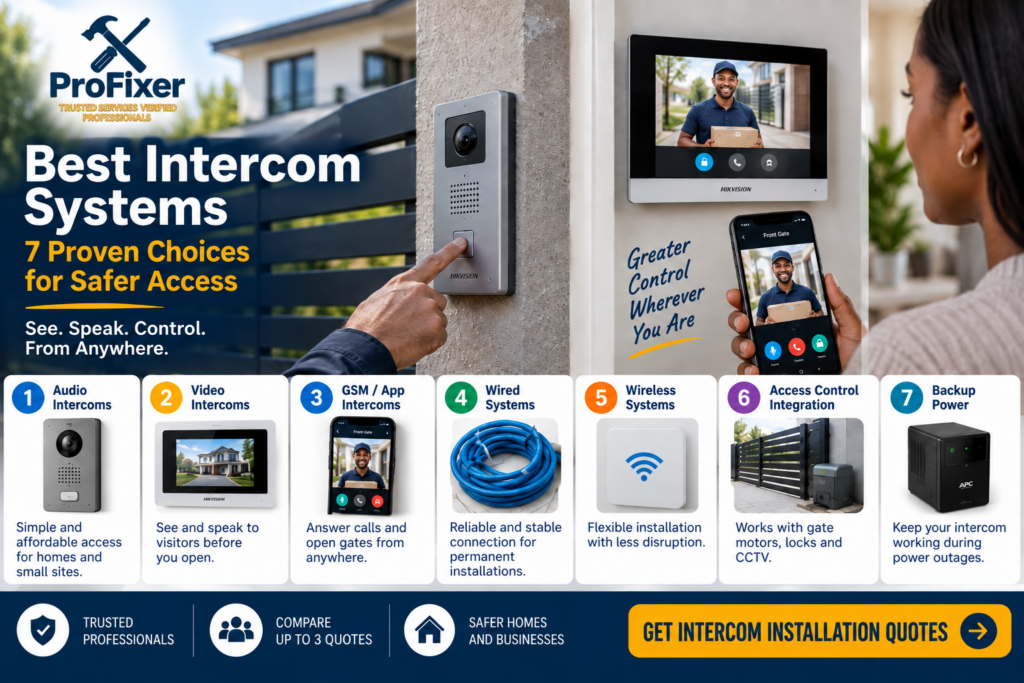
Audio intercoms for straightforward access
Audio intercoms let a visitor press a button and speak to someone inside. They are usually the most affordable option and can be a sensible choice for smaller homes, staff entrances and low-risk areas where visual identification is not essential.
Their main limitation is obvious: you can hear a visitor, but you cannot see them. That may be acceptable where the gate is already monitored by a separate camera or where the intercom is used mainly for internal communication. For many homeowners, however, a video option provides greater confidence before releasing a lock or gate.
Video intercoms for better visitor checks
Video intercoms combine two-way audio with a camera at the entrance. A screen inside the property shows who is calling, making it easier to identify visitors, couriers and contractors before granting access.
Image quality matters, especially at night. Ask about low-light performance, night vision and camera positioning. A camera aimed directly into the afternoon sun, mounted too high, or placed where a gate motor blocks the view can produce poor results regardless of the unit’s specifications.
Video systems work well at homes, offices, clinics and retail premises. They are particularly useful where a receptionist is not always at the entrance, or where family members want to check a caller without approaching the door.
GSM and mobile app intercoms
GSM intercoms use a SIM card to call selected phone numbers when a visitor presses the call button. App-enabled models can send a notification to a smartphone, allowing you to answer from elsewhere on the property or while away.
This is convenient for landlords, holiday homes and small businesses where no one is stationed at a desk all day. It can also help when a delivery arrives while you are working in another part of the building.
There are trade-offs. GSM systems rely on mobile network coverage and may have ongoing SIM or data costs. App-connected systems rely on a stable internet connection, suitable Wi-Fi coverage at the gate and proper account security. If the entrance is far from the router, an installer may recommend a network extension, outdoor access point or a different system type.
Wired versus wireless systems
Wired intercoms are often the dependable choice for permanent installations. A cable connection can provide stable communication and power, with less risk of interference. The work may take longer if cables need to run underground, through walls or across a large site, but it is often worthwhile for a property that needs reliable daily access control.
Wireless intercoms can reduce installation disruption and may be useful where trenching is difficult. However, walls, steel gates, distance and nearby wireless devices can affect performance. Do not choose wireless purely to save on installation without checking the actual signal path first.
Match the system to your property
A good intercom is not simply a device on a gatepost. It should suit how people enter and leave the property every day.
At a family home, convenience may mean answering from a kitchen handset or mobile phone and releasing a pedestrian gate remotely. If there is an automated driveway gate, confirm that the intercom can work with the existing gate motor and safety controls. The release function should be installed correctly so that it does not compromise security or prevent safe exit in an emergency.
At a rental property, durability and easy management matter. A landlord may prefer a system that supports changing resident numbers without replacing hardware. For a block of flats, a multi-unit panel with clear labelling and individual calling functions can reduce confusion for visitors and service providers.
For offices and commercial sites, consider visitor traffic. A small studio may need only a video doorbell-style unit, while a warehouse, school or business park may need multiple entry stations, access cards and integration with gates, barriers or CCTV. Reception staff should be able to use the system quickly, especially during busy periods.
Complexes and estates usually need a more detailed assessment. The number of residents, visitor procedures, guardhouse operations and emergency access requirements all influence the design. An intercom that works well for six units may be unsuitable for sixty.
Features worth paying for
The best intercom systems are not necessarily the ones with the longest feature list. They are the systems that provide reliable communication, suitable access control, good visitor identification and practical backup power for the way the property is actually used.
Not every feature is necessary, but a few can make a meaningful difference to daily use. Look for clear two-way audio, a weather-resistant outdoor panel and reliable gate or door release where required. If you choose video, check that the camera provides a useful field of view and performs well after dark.
For properties with frequent deliveries or several occupants, call forwarding and multiple authorised users can be valuable. A resident should not be locked out of the system because only one person’s phone is registered. For business premises, audit trails or access logs may help management review who entered and when.
Backup power deserves attention in South Africa. If an intercom is connected to a gate motor, Wi-Fi router or power supply that shuts down during an outage, it may not be available when you need it. Ask an installer whether the system can be supported by the existing gate battery, UPS or inverter setup, and how long that backup is expected to last.
Avoid buying based only on a long feature list. A system that needs frequent app resets, has poor after-sales support or cannot be repaired locally can become expensive and frustrating.
What affects intercom installation costs?
When comparing the best intercom systems, look at the full installation cost rather than the price of the entrance unit alone. Cabling, gate integration, electric locks, network equipment and additional indoor stations can all affect the final quote.
Intercom costs vary because the installation work can be more significant than the device itself. A basic unit fitted close to the house is a different job from a video system at a street gate with underground cabling, electric lock integration and multiple indoor stations.
The main cost factors are the type of system, the distance between the entrance and building, the condition of existing wiring, the number of gates or doors, and whether the work includes a gate motor, electric strike, magnetic lock, camera or network equipment. Brickwork, trenching, conduit and weatherproof enclosures may also be needed.
Ask for a written quote that separates equipment, labour and any additional electrical or access-control work. It should state what happens if extra cabling or repairs are discovered after work begins. This makes it easier to compare like for like rather than selecting a low headline price that excludes key parts of the installation.
Questions to ask an intercom installer
Before booking, explain how the property is used and where the entrance points are. A capable installer should ask about gate motors, existing security equipment, mobile signal, Wi-Fi coverage and power backup rather than recommending the same unit for every job.
It is also sensible to ask whether the system can be expanded later, what warranty applies to the equipment and workmanship, and who will assist if there is a fault. For app or GSM systems, confirm who owns the account, who manages the SIM card and how user access is removed when tenants or staff leave.
Take the opportunity to discuss placement. The outdoor panel needs to be reachable for visitors but not exposed to unnecessary damage. Indoor screens or handsets should be positioned where they can be heard and used easily, not hidden in a seldom-used room.
Get the right local help
An intercom installation sits between security, electrical work and access control, so the quality of the assessment matters as much as the equipment. A local professional can inspect the site, identify practical limitations and recommend a setup that matches your budget without leaving gaps in the system.
With Profixer, you can post your intercom installation or repair job free and connect with local security and access-control contractors interested in quoting for the work. Include the property type, number of entrances, existing gate motor or CCTV equipment, and whether you need audio, video, GSM or mobile-app access so contractors can recommend a suitable system.
Choosing the best intercom systems comes down to matching the technology to the property, visitor traffic, gate or door controls, network coverage and backup-power needs. Compare systems on reliability, installation quality, expandability and ongoing support rather than choosing the cheapest unit alone.
GET INTERCOM INSTALLATION QUOTES