

7 Essential Steps to Install Backup Power Safely
When the lights go out halfway through a working day, it is tempting to buy the first inverter or generator available and get it connected immediately. But to install backup power safely, the system must suit your property, protect your appliances and be connected by a qualified professional. A rushed installation can create shock, fire and back-feed risks, while an undersized system can leave you with costly equipment that still cannot run what you need.
Backup power is not one product. It is a combination of a power source, batteries or fuel, protective devices, cabling, changeover equipment and the circuits you choose to support. The right setup for a small flat will look very different from one for a family home, rental building, shop or office.
Table of Contents
Before you install backup power safely
Start by deciding what must stay on during an outage. For many homes, the priority is Wi-Fi, lights, phone charging, a television, security systems, a fridge and a few plug points. A business may also need computers, point-of-sale equipment, access control, CCTV, network equipment or an essential refrigeration load.
This is where good planning saves money. Heavy loads such as electric stoves, geysers, pool pumps, air conditioners, tumble dryers and large kettles can quickly overwhelm a modest inverter and battery system. You may be able to include selected appliances, but each one changes the size, cost and battery runtime required.
Ask a contractor to assess the actual loads rather than relying only on a product label or an online estimate. They should establish the running wattage, starting surge where relevant, expected duration of outages and whether you want to add solar panels later. A system that runs essential circuits for four hours may be the sensible option; whole-property backup can be possible, but it is usually a much larger investment.
Choose the system that matches the job
An inverter and battery system is a popular choice for quiet indoor backup of selected circuits. It can switch quickly when grid power fails and, when designed correctly, protect sensitive electronics with a stable supply. Battery capacity determines how long it can run, while inverter capacity determines how much it can run at once.
A solar hybrid system combines an inverter, batteries and solar generation. It can reduce reliance on the grid and recharge batteries during daylight, but its design needs careful attention to roof space, shading, panel layout, approvals and future maintenance. Solar panels do not automatically mean you have backup power: the inverter and battery arrangement must be designed for it.
A generator may suit sites that need long-duration backup, higher loads or a lower upfront cost. It also brings fuel storage, noise, exhaust fumes, servicing and safe changeover requirements. Generators must never run indoors, in garages or close to doors, windows and air intakes. Carbon monoxide is colourless and odourless, and poor placement can be fatal.
Portable power stations can be useful for limited loads such as laptops, routers and lights. They are not a substitute for a properly designed fixed installation when you need to power circuits, large appliances or security equipment reliably.
Safe electrical connection is not optional
To install backup power safely, the backup supply must be correctly isolated from the grid and protected by suitable changeover, earthing and circuit-protection equipment.
The most serious risk in backup power work is an incorrect connection to the mains supply. Back-feeding can send electricity into the utility network when it should be isolated. This can damage equipment and put technicians working on power lines at risk.
A fixed inverter or generator installation should use suitable isolation and changeover equipment so that grid and backup supply cannot feed each other unintentionally. Essential circuits may be moved to a dedicated backup distribution board, while high-demand circuits remain on the normal supply. The electrician should also check earthing, bonding, cable sizing, circuit protection and surge protection.
Do not use improvised leads, double adaptors or a plug-to-plug connection to energise household wiring. These shortcuts are dangerous even if they appear to work. Likewise, avoid routing loose cables under carpets, through windows or across walkways where they can be crushed, overheat or cause trips.
In South Africa, electrical installation work must meet applicable regulations and standards. Ask whether a Certificate of Compliance is required for the scope of work and ensure the installer provides the correct documentation. If your property is part of a sectional title scheme, complex or commercial building, check the body corporate, landlord or facilities requirements before work begins. There may also be rules for generator noise, fuel storage, solar equipment or changes to common property.
Batteries need the right environment
Lithium batteries are widely used because they are compact and offer good cycle life, but they still need suitable protection and installation conditions. Use compatible equipment from reputable suppliers, and do not mix battery types, brands or old and new batteries unless the manufacturer specifically permits it.
The battery location should be dry, secure, accessible for servicing and away from direct heat. It should not block an escape route or sit where children can tamper with it. Requirements vary by battery chemistry and system design, so follow the manufacturer guidance on clearances, ventilation and enclosure type.
Lead-acid batteries generally need more ventilation and maintenance than lithium units. They can release gases during charging and may contain corrosive electrolyte. A contractor should specify the correct battery type for the location rather than simply fitting what is cheapest.
Get the installation right from day one
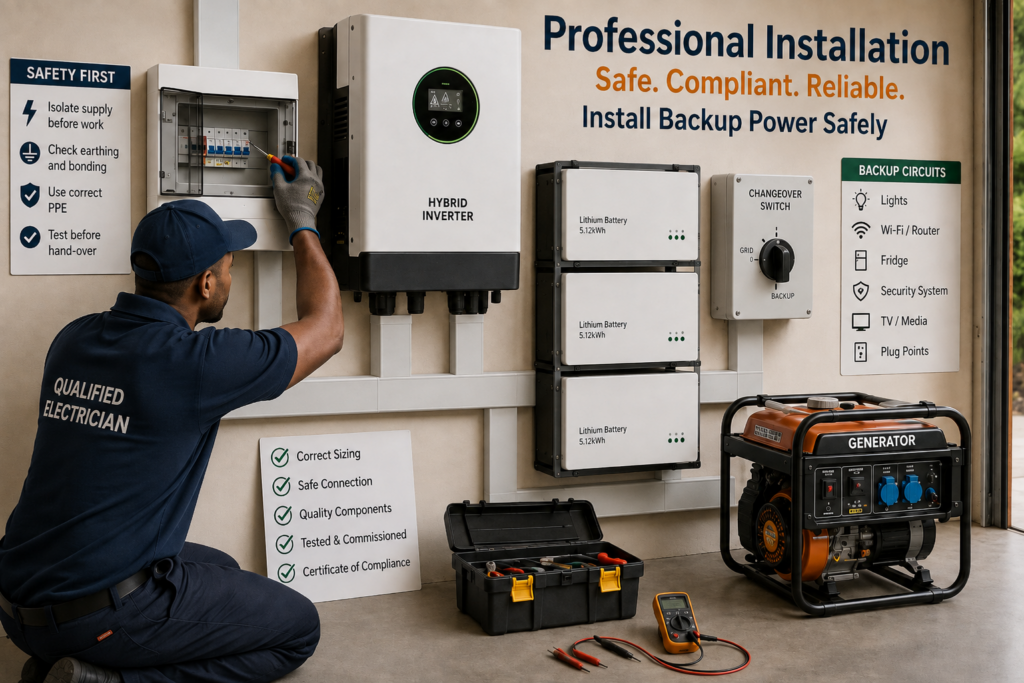
A qualified contractor should explain exactly how they will install backup power safely, which circuits will be supported and what protection and compliance work is included.
A reliable installer will not only quote for an inverter and battery. They will inspect the distribution board, identify the circuits to be backed up, calculate likely demand and explain the limits of the proposed system. They should give you a clear scope covering equipment, labour, protection devices, commissioning, warranty terms and any certification.
It is worth comparing more than one quote, especially for larger solar or generator projects. The lowest price may exclude essential items such as a changeover switch, mounting hardware, cable upgrades, surge protection, monitoring, enclosure work or compliance documentation. Compare what is included, not just the headline figure.
Before accepting a quote, ask these practical questions in conversation: Which appliances and circuits will work during an outage? For how long under typical use? What happens if several high-load appliances are switched on? Can the system be expanded later? Who handles faults and warranty claims? What documents will I receive after installation?
For landlords and property managers, it is also wise to decide who controls the equipment and who is responsible for servicing. Label the backed-up plug points and distribution board clearly. Tenants and staff should know that a backup circuit is not unlimited power.
Use backup power without damaging it
Once the system is installed, habits matter. Avoid switching on several heat-producing appliances at once, particularly during an outage. A kettle, microwave, heater and hair dryer can exceed the inverter rating even if each appliance works individually. Prioritise refrigeration, communication, lighting and security first.
Check the monitoring display or app regularly if your system has one. Repeated overload warnings, unexpectedly short runtime or batteries that do not charge fully deserve attention. Do not ignore burning smells, unusual heat, loose fittings, tripping breakers or discoloured plugs. Switch off the affected equipment where safe and arrange an inspection.
Generators need a maintenance routine too. Run them according to the manufacturer schedule, keep fuel stored safely and have servicing carried out by a competent provider. Old fuel, blocked filters and neglected oil levels are common reasons a generator fails when it is most needed.
A well-planned backup system should make outages less disruptive, not introduce a new hazard into your property. With Profixer, you can post your backup-power requirements free and connect with local electricians, solar installers and backup-power specialists interested in quoting for the work. Compare the proposed capacity, protection equipment, installation scope, warranty and price before choosing a contractor.
If you want to install backup power safely, start with your essential loads and use a qualified professional to design, connect and commission the system correctly. The right installation should protect your property as well as keep it powered.
GET BACKUP POWER INSTALLATION QUOTES