
Contractor Reviews: 7 Proven Signs You Can Trust
A leaking geyser, faulty gate motor or urgent electrical problem rarely leaves much time for guesswork. Contractor reviews can help you narrow down the options quickly, but only if you know what you are looking at. A five-star rating is useful, yet it does not tell you whether a contractor is right for your specific job, budget, location or deadline.
The best reviews give you a clearer picture of what it is like to work with someone. They show whether the contractor arrives when promised, explains costs properly, respects the property and resolves problems without disappearing halfway through the job. Used alongside clear quotes and a proper scope of work, reviews can help you choose with far more confidence.
Table of Contents
Why contractor reviews need a closer look
Property work is personal. You may be allowing a plumber into your home, asking an electrician to work on a distribution board, or trusting a builder with a renovation that affects your tenants or trading hours. The cheapest quote is not always the best value, and the contractor with the highest average score is not automatically the best fit.
Reviews are most helpful when they answer practical questions. Was the job similar to yours? Was the customer told about extra costs before work continued? Did the contractor return to fix a snag? Were the workers tidy and professional? A short comment such as “Great service” is positive, but it gives you little to use when comparing providers.
Look for patterns rather than one glowing or unhappy review. Even good contractors can have a difficult job or a customer whose expectations could not be met. Repeated comments about poor communication, late arrivals or unfinished work deserve more attention than a single complaint. The same applies to repeated praise for punctuality, fair pricing and quality workmanship.
7 signs contractor reviews are worth trusting
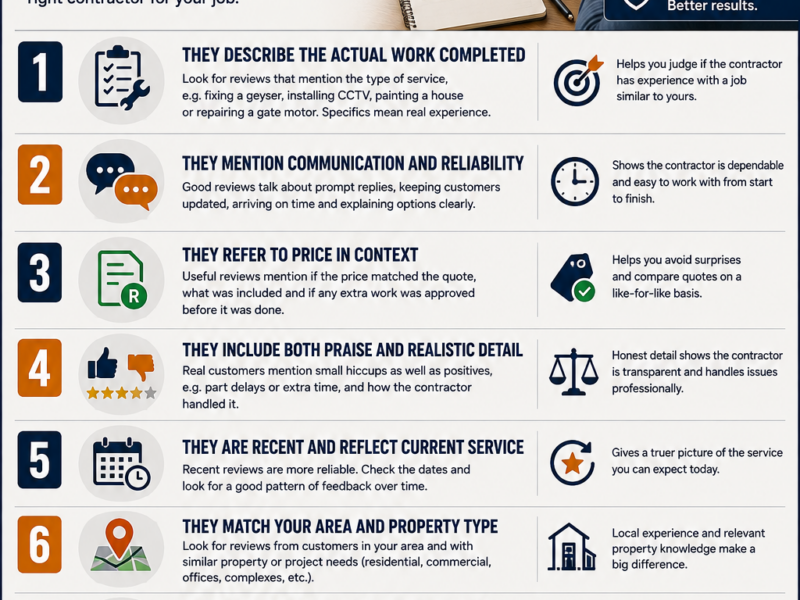
1. They describe the actual work completed
The strongest reviews mention the service provided. A customer may refer to repairing a burst pipe, installing CCTV cameras, repainting a flat, servicing an air conditioner or replacing a gate motor. Specifics suggest the feedback comes from a real experience rather than a vague endorsement.
This also lets you judge relevance. A contractor praised for routine garden maintenance may still be a poor match for a complex landscaping project. Likewise, a company that installs solar systems may have excellent reviews, but you should check whether those comments relate to the type of backup solution and property size you need.
2. They mention communication and reliability
Good workmanship matters, but so does the experience around it. Reviews that mention prompt callbacks, clear booking arrangements, updates about delays and straightforward explanations are particularly valuable. For landlords and property managers, reliable communication can be as important as the repair itself because tenants, access arrangements and maintenance records all need managing.
Pay attention to comments about how a contractor responds when plans change. Additional damage behind a wall, unavailable parts or bad weather can affect a job. The key question is whether the contractor explains the issue, discusses the options and agrees any revised cost before proceeding.
3. They refer to price in context
A review saying “best price” can be encouraging, but low cost alone is not a quality measure. Useful reviews explain whether the price matched the quote, whether the customer understood what was included and whether any additional work was approved first.
Compare like for like. One quote may include materials, labour, call-out fees, VAT, rubble removal and a workmanship guarantee, while another covers only labour. A slightly higher figure can be the better choice if the scope is clear and there are fewer surprises later.
4. They include both praise and realistic detail
A long list of perfect, nearly identical reviews can be less useful than a mix of honest experiences. Genuine customers often mention a small inconvenience alongside a positive result: perhaps a part had to be ordered, the job took an extra day, or an arrival time changed after notice was given.
That does not mean you should seek out negative feedback. It means you should value detail over perfection. A contractor who handled a delay professionally may be a safer choice than one whose reviews offer only broad claims with no evidence behind them.
5. They are recent enough to reflect current service
Businesses change. A contractor may have grown their team, moved service areas, changed suppliers or taken on more complex work. Recent reviews are more likely to reflect the service you will receive now.
Older feedback still has value, especially when it shows a history of satisfied customers. However, if the most recent comments raise concerns about missed appointments or declining quality, do not rely on a strong rating built several years ago. Check the dates and look at the latest pattern.
6. They match your area and type of property
Local knowledge can make a real difference. A contractor working regularly in your area may understand access restrictions, common property layouts, local suppliers and realistic travel times. This is especially useful for urgent call-outs in larger cities and for properties outside main urban centres.
Commercial work can also require different experience from residential work. If you manage an office, retail site, complex or rental portfolio, look for comments that mention coordination, safety requirements, reporting, after-hours work or minimal disruption. The right contractor reviews will reflect the type of responsibility you need them to handle.
7. The contractor responds professionally to concerns
No service business can prevent every complaint. What matters is how it reacts. A calm, practical response that acknowledges the issue and offers to investigate is a good sign. An aggressive reply, excuses without solutions or public arguments with customers should make you cautious.
If you are considering a contractor after reading mixed feedback, ask them directly about the concern. Their response can tell you a great deal. A dependable professional should be willing to explain their process for quotations, changes to scope, guarantees and follow-up work.

How to use reviews with quotes and checks
Good contractor reviews should support what you see in the quote, especially around communication, reliability, workmanship and how problems are handled after the job starts.
Reviews should support your decision, not make it for you. Once you have found a few promising local contractors, provide each one with the same clear job description. Include photographs where useful, the property location, the urgency, access details and exactly what outcome you need. This gives you a fairer basis for comparing responses.
Ask for a written quote that sets out labour, materials, exclusions, timeframes and payment terms. For substantial jobs, such as renovations, solar installations, roofing or security upgrades, ask how variations will be approved and what guarantee applies to the completed work. Do not assume an item is included simply because it seems necessary.
It is sensible to check that the contractor has relevant experience, appropriate insurance where required and any qualifications or compliance documents the job calls for. Electrical work, gas installations and certain construction projects can involve formal safety requirements. Reviews may tell you a contractor was pleasant to deal with, but they do not replace the checks needed for regulated work.
For a small repair, you may prioritise speed, availability and transparent call-out pricing. For a larger project, experience, planning and clear documentation usually matter more than getting the lowest figure on the first day. It depends on the risk, the value of the work and how difficult it would be to correct a poor result.
Red flags that deserve a pause
When reading contractor reviews, repeated complaints about changing prices, poor communication or unfinished work deserve more attention than one isolated negative comment.
Be careful when a contractor pressures you to decide immediately, will not provide a written quote or asks for a large upfront payment without explaining what it covers. Reviews that repeatedly mention cash-only requests, changing prices, unreturned calls or incomplete work should not be ignored.
You should also be cautious of reviews that sound copied, appear in a sudden burst or use the same wording across different businesses. They may not always be unreliable, but they are not enough to base a decision on. Ask practical questions and compare more than one option.
A free quote-comparison service can reduce the time spent searching. With Profixer, customers can post a job free and connect with local contractors interested in quoting for the work. Compare their reviews, proposed scope, availability, guarantees and pricing before deciding who to appoint.
Make your decision easier, not rushed
The right contractor is not simply the person with the most stars or the lowest price. It is the professional who understands the work, communicates clearly, quotes honestly and has feedback that supports those claims. Give yourself enough information to compare the options, then choose the provider you would feel comfortable calling if something needed attention after the job is done.
A good review should leave you with useful questions to ask, not pressure to click “hire”. When the answers, quote and customer feedback all point in the same direction, you are far more likely to get the result your property needs.
The most useful contractor reviews give you evidence of how a contractor communicates, prices the work and responds when something does not go to plan. Use that feedback alongside a clear written quote and the right checks for the job before making your final choice.
GET CONTRACTOR QUOTES