
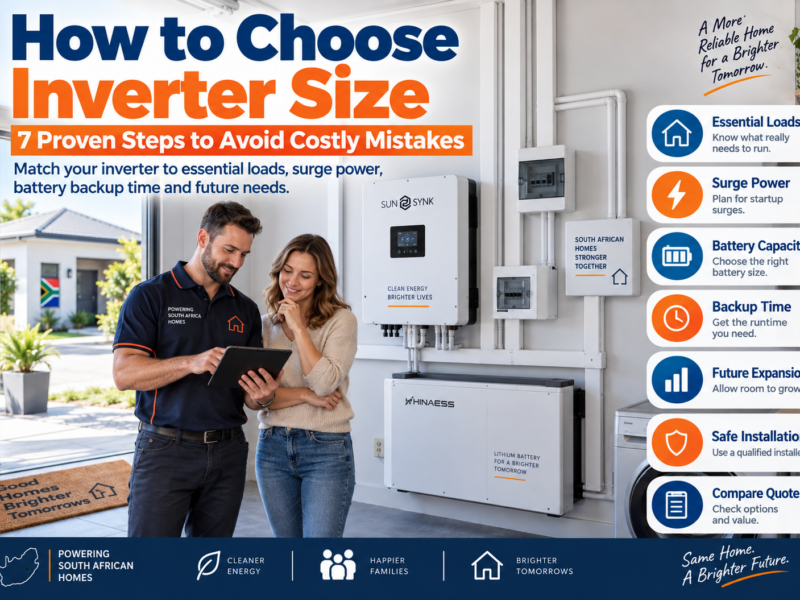
How to Choose Inverter Size: 7 Proven Steps to Avoid Costly Mistakes
When power cuts interrupt work, security, refrigeration or everyday routines, buying the biggest inverter you can afford is not always the best answer. Knowing how to choose inverter size means matching the system to the appliances you genuinely need to run, the way you use them, and the battery backup time you expect.
A correctly sized inverter can keep essential circuits running reliably without wasting money on equipment that is too large for the job. An undersized unit, on the other hand, may trip, shut down or struggle when a fridge, pump or gate motor starts. For a home, flat, shop, office or rental property, the right starting point is a clear list of your priority loads.
Table of Contents
How to choose inverter size: start with your essential loads
An inverter changes battery power into the AC electricity used by normal plugs and appliances. Its size is usually shown in watts (W), kilowatts (kW), volt-amperes (VA) or kilovolt-amperes (kVA). The most useful number for most property owners is its continuous output in watts or kilowatts: the amount it can supply steadily while appliances are running.
Do not begin by adding every electrical item in the building. During an outage, most people do not need the oven, geyser, tumble dryer, pool pump and air conditioners all running at once. Focus on what must stay on. This often includes lights, Wi-Fi, phones and laptops, a television, fridge-freezer, selected plug points, an alarm, CCTV and an automated gate.
For a small backup setup, a typical essential-load list may look like this:
| Appliance or circuit | Typical running power | |—|—:| | Fibre router and ONT | 15-30 W | | Four LED lights | 30-50 W | | Laptop | 50-100 W | | Television | 80-200 W | | Fridge-freezer | 100-250 W | | Alarm and CCTV | 30-150 W |
These are broad estimates, not design figures. Check each appliance label, manual or plug-in energy meter where possible. Fridges, freezers, pumps and motors can use very different amounts depending on their age, size and condition.
Add the watts of appliances that may operate at the same time. If your likely combined running load is 700 W, do not select a 700 W inverter. Leave headroom for variations in demand, battery charging losses and future needs. A practical allowance is often 20% to 30%, provided the unit can also handle the start-up demands discussed below.
Watts, VA and kVA are not always the same
It is easy to see a 3 kVA inverter and assume it provides 3,000 W. That is not always true. VA and kVA describe apparent power, while watts describe real power. The difference depends on power factor, which varies by appliance and inverter design.
For example, a 3 kVA inverter with a power factor of 0.8 may have a continuous rating of 2.4 kW. Another 3 kVA model may be rated closer to 3 kW. Always compare the manufacturer’s stated continuous watt output, surge rating and battery voltage rather than choosing by kVA alone.
This matters particularly in offices and commercial spaces, where computers, printers, network equipment, access control and refrigeration can create a larger combined load than expected. A contractor should calculate the proposed system against the actual equipment rather than relying on a generic package label.
Allow for start-up surges
Some appliances need a short burst of extra power when they start. A fridge compressor, borehole pump, gate motor, freezer and certain power tools can draw several times their normal running wattage for a few seconds. This is called a start-up surge or inrush current.
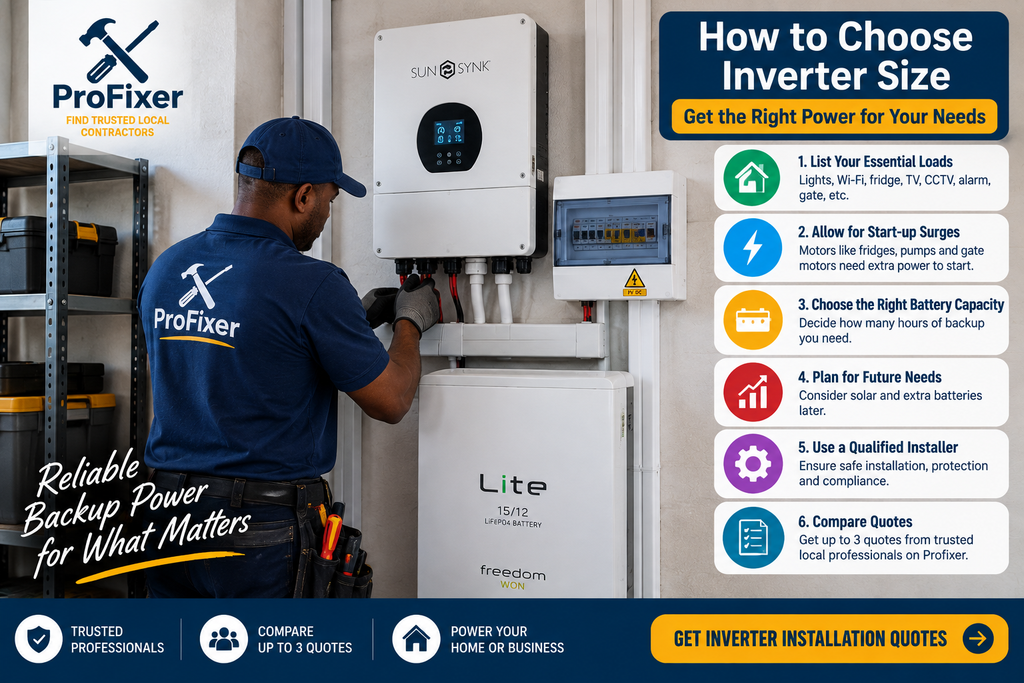
An inverter may be able to run a 200 W fridge once the compressor is operating but still fail if its surge capacity is too low when the compressor starts. Check both the continuous rating and the peak or surge rating. If motors are part of the backup load, tell the installer exactly which appliances you want to run and whether they could start at the same time.
In some cases, the sensible solution is not a dramatically larger inverter. It may be separating high-draw equipment from the backup circuit, fitting a soft starter where suitable, or managing when certain appliances run.
Choose the battery capacity separately
Understanding how to choose inverter size also means separating inverter output from battery capacity. The inverter determines how much equipment can run at once, while the battery determines how long those loads can remain powered.
Inverter size answers the question, “How much can I run at once?” Battery capacity answers, “How long can I run it?” The two decisions work together, but they are not interchangeable.
A large inverter with a small battery bank may power many appliances briefly, then run flat. A sizeable battery bank paired with a small inverter can store plenty of energy but cannot supply a high-demand load. Your installer should size both elements around your expected usage during an outage.
Battery capacity is usually expressed in kilowatt-hours (kWh). As a simple guide, if your essential loads average 800 W, they use about 0.8 kWh per hour. Over four hours, that is roughly 3.2 kWh of energy before allowing for inverter losses, battery reserve and changes in appliance use.
Lithium batteries generally offer more usable capacity and longer cycle life than older lead-acid options, but their upfront cost is higher. The best option depends on budget, daily cycling, available space and how often you expect the system to be used. Battery specifications can be confusing, so ask for the usable kWh, expected warranty terms and any limits on adding batteries later.
Consider what will change in the next two years
A system that fits today’s load may feel restrictive after a home office is added, a tenant moves in, more cameras are installed or a solar array is planned. You do not need to pay for every possible future upgrade now, but it is worth checking whether the inverter can expand.
Ask whether additional batteries can be added, whether solar panels can be connected later, and whether the distribution board has been designed with spare capacity. If you may eventually want to support larger loads such as selected kitchen circuits or a small business’s essential equipment, choosing a compatible upgrade path can avoid replacing the whole system.
At the same time, avoid future-proofing so aggressively that the project no longer suits your budget. A well-designed essential-load system is often more useful than an oversized installation that delays the work altogether.
Match the inverter to the installation environment
The inverter itself needs a safe, suitable location. It should be installed in a dry, ventilated area with enough space for servicing, away from direct heat and according to the manufacturer’s clearance requirements. Battery placement, cable routes, circuit protection and earthing all affect safety and performance.
For homes and commercial properties, the installation should be planned by a qualified electrician or solar and backup-power professional. Connecting an inverter incorrectly can create shock, fire and equipment-damage risks. It can also cause problems with municipal supply connections, changeover arrangements and certificate-of-compliance requirements.
Pure sine wave inverters are normally the preferred choice for sensitive electronics, modern appliances and motor-driven loads because they provide cleaner power similar to the mains supply. Lower-cost alternatives may suit limited uses, but they can cause noise, excess heat or unreliable operation with certain equipment.
Do not forget charging speed
After a long outage, the battery must recharge. If charging is too slow for your pattern of use, the system may not recover before the next interruption. Check the inverter’s charging capability, the available supply, battery manufacturer limits and whether solar charging will be included.
This is particularly relevant for properties that experience repeated outages or use a backup system daily. A professional can balance battery protection with a recharge rate that is practical for your household or business.
Get quotes based on the same brief
When comparing systems, knowing how to choose inverter size makes it easier to identify quotes that are properly matched to your essential loads instead of simply selecting the largest or cheapest package.
To compare inverter quotes fairly, give each contractor the same information: your list of essential appliances, their wattage where known, the hours of backup you want, whether you plan to add solar, and any equipment with motors or heating elements. Ask each provider to specify the inverter’s continuous watt rating, surge rating, battery usable capacity, installation scope, protection equipment and warranty.
A lower quote may exclude wiring changes, a changeover switch, a certificate of compliance, mounting equipment or after-sales support. A higher quote may include better batteries or capacity for expansion. Looking at the full scope, rather than the headline price, helps you make a budget-conscious decision.
With Profixer, you can post your inverter or backup-power project free and connect with local electrical and solar professionals interested in quoting for the work. Compare inverter capacity, usable battery storage, surge capability, installation scope, circuit protection, warranties and future solar compatibility before choosing a provider.
The right inverter is the one that keeps your priority equipment working safely, gives you realistic backup time and leaves room for the property needs you can reasonably see ahead.
Knowing how to choose inverter size helps you avoid paying for unnecessary capacity while ensuring your essential equipment keeps running when the power goes off. Calculate the loads you genuinely need, allow for start-up surges, decide how many hours of backup you require and compare systems designed around the same requirements.
GET INVERTER INSTALLATION QUOTES