
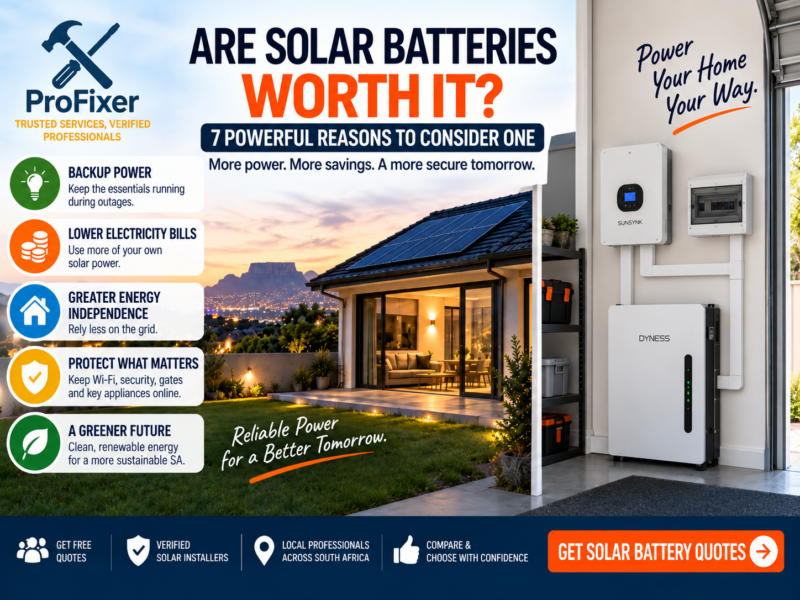
Are Solar Batteries Worth It? 7 Powerful Reasons to Consider One
When a power cut stops the Wi-Fi, trips an electric gate or leaves a home office without power, a battery can feel less like a luxury and more like a practical necessity. But are solar batteries worth it for every South African property? The honest answer is that it depends on what you need the system to do, how much electricity you use and how long you plan to stay in the property.
A solar battery stores electricity for use later. It can charge from your solar panels during the day and supply selected appliances at night or during an outage. In many systems, it can also charge from the grid when needed. That makes it useful for more than load shedding: it can reduce reliance on peak-rate electricity, provide backup during local faults and help you use more of the solar power your panels produce.
The key is to buy a system sized for your real needs, not the biggest battery your budget can stretch to.
Table of Contents
Are solar batteries worth it when the grid is available?
For many households, solar panels alone already reduce daytime electricity costs. The challenge is that a typical home often uses most of its electricity early in the morning and after sunset, when panels are producing little or nothing. Without a battery, surplus daytime solar power may go unused unless your local municipality allows export to the grid and your system is set up for it.
A battery lets you keep some of that daytime generation for the evening. If your household runs lights, Wi-Fi, televisions, a fridge, security equipment and a few plugs after dark, that stored energy can make a noticeable difference to grid consumption.
It is especially worthwhile where electricity use is consistent and the battery will cycle regularly. A battery that is charged and used most days is generally delivering more value than one installed only for occasional outages.
However, a battery is not always the fastest route to savings. If your roof has space but your solar array is small, adding more panels may produce a better return before adding battery capacity. Panels generate the energy in the first place; the battery only stores what is available. A good solar installation contractor should assess both parts together.
The value of backup power is personal
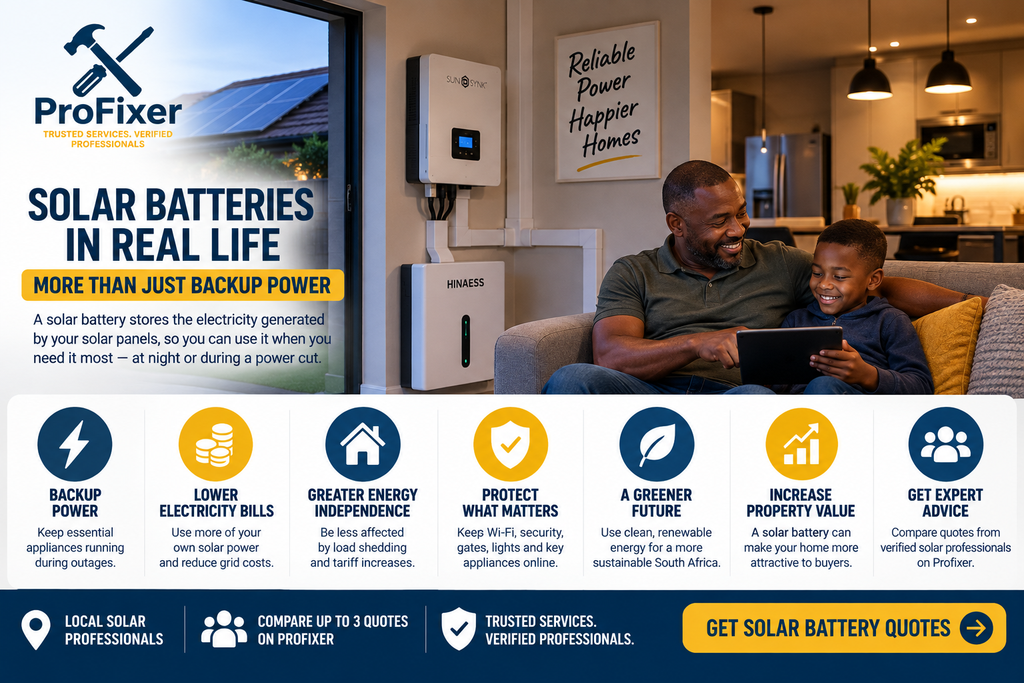
Financial payback matters, but it is not the only measure. For a family with no medical equipment, no remote working requirements and few interruptions, backup power may be a convenience. For someone working from home, managing a rental property or running a small business from a home office, it can protect income and reduce disruption.
Landlords and property managers may also see value beyond their own electricity bill. Landlords and property managers may also see value beyond their own electricity bill. Reliable backup for access control, CCTV, electric fencing, alarm systems, internet equipment and common-area lighting can improve tenant experience and reduce operational headaches.
For shops, offices and other commercial sites, the calculation can be even clearer. A short outage can interrupt card payments, security, refrigeration, communications or essential equipment. In those cases, the cost of downtime should be compared with the cost of a properly designed backup system.
That said, a solar battery will not automatically power an entire property. High-draw appliances such as electric ovens, geysers, pool pumps, underfloor heating, air conditioners and tumble dryers can drain a battery quickly. Whole-home backup is possible, but it needs a larger battery bank, a capable inverter and a bigger budget.
Start with the loads you cannot afford to lose
Before requesting quotes, decide what must remain on during an outage. Most households prioritise the fridge, lights, fibre router, television, charging points, selected plug circuits and security equipment. Some may add a gate motor, garage door, computer setup or a small microwave.microwave.
This is often called the essential-loads circuit. Separating these circuits helps keep the system affordable because the battery is not trying to run every appliance in the house.
Think about both power and time. Power is how much the appliance needs at one moment, while battery capacity determines how long it can run. A fridge may use moderate power but runs on and off throughout the day. A kettle uses high power for a short period. An electric heater may look manageable at first but can use a large share of stored energy over several hours.
A practical installer will ask about your appliances, household routine, electricity bills and preferred backup duration. They should explain what will and will not be supported rather than promising that one battery will handle everything.
Costs, lifespan and the real return on investment
If you are asking are solar batteries worth it, compare the usable battery capacity, expected cycle life, warranty and electricity savings rather than judging the system only by its upfront price. If you are still deciding between battery types, our guide to inverter battery versus solar battery explains the differences in cycle life, charging, usable capacity and long-term value.
The upfront cost of a solar battery system includes more than the battery itself. It may include an inverter, panels, mounting equipment, wiring, protection devices, labour, compliance work and changes to your distribution board. If you already have solar panels, your existing inverter may or may not be compatible with battery storage.
Lithium iron phosphate batteries are widely used in residential systems because they offer good cycle life and a strong safety profile. Even so, all batteries have a finite lifespan. Their useful life is affected by how deeply they are discharged, how often they cycle, operating temperature, product quality and installation standards.
When comparing systems, do not focus only on the advertised battery size. Ask for the usable capacity, expected warranty terms, cycle rating, inverter output and the conditions that apply to the warranty. A lower-priced unit may have less usable storage or a shorter warranty, while a larger system may be unnecessary for your essential loads.
Electricity tariffs also affect the payback period. A property that buys expensive grid electricity in the evening and uses stored solar energy at that time may see stronger savings than a home with very low consumption. Rising electricity prices can make self-generated power more valuable over time, but it is sensible to treat projections as estimates rather than guarantees.
When a battery may not be the right first purchase
A battery is not automatically the best choice for every property. If your monthly electricity use is low, your daytime consumption is already covered by solar panels, or you mainly want occasional light backup, a smaller system may be more suitable. In some cases, improving energy efficiency first will reduce the size and cost of the system you need.
Replacing inefficient appliances, fitting LED lighting, managing geyser use and placing pool-pump schedules in daylight hours can lower demand without relying on stored electricity. These changes also help a future battery last longer during an outage.
Properties with limited roof space, significant shading or an ageing electrical installation may need other work before solar and storage can perform properly. Likewise, tenants should check their lease and get written approval before making permanent electrical changes.
Compare quotes on the same specification
A qualified electrician may also need to assess the distribution board, circuit protection and existing wiring before a new battery or hybrid inverter system is connected.
The answer to are solar batteries worth it becomes much clearer when several installers quote against the same essential loads, backup duration and electricity-use requirements.
Solar battery quotes can look very different even when the headline battery size appears similar. To compare fairly, give each installer the same brief: the appliances you want backed up, the expected outage duration, your current electricity use and whether you have existing panels or an inverter.
Ask each provider to set out the battery brand and usable capacity, inverter size, number and rating of panels, essential circuits included, warranty coverage, installation timeline and any exclusions. Also confirm whether electrical compliance documentation and municipal or utility requirements are included where applicable.
The cheapest quote is not always the best value. A system that is undersized can cause frustration, while an oversized system may take much longer to justify financially. Look for a clear design, realistic performance expectations and a contractor who is willing to answer practical questions before installation.
With Profixer, you can post your solar battery project free and connect with local solar installers interested in quoting for the work. Compare battery capacity, inverter size, solar panels, backup circuits, warranties, compliance work and total installation cost before choosing a provider.
A sensible way to decide
Solar batteries are often worth it when they solve a real problem: protecting essential power, using more of your own solar generation or reducing disruption at a home or business. They are less compelling when they are bought without a clear plan for usage, capacity and long-term cost.
Start with the moments when power matters most on your property. Once you know which appliances need to keep running and for how long, you can ask installers for a system that fits the job, compare the details carefully and choose with confidence.
So, are solar batteries worth it? They often are when they help you use more of your own solar power, protect essential appliances during outages or reduce disruption to your home or business. Start with the loads you genuinely need to support, then compare properly sized systems rather than simply buying the largest battery you can afford.
With Profixer, you can post your solar battery project free and connect with local solar installers interested in quoting for the work. Compare battery capacity, inverter size, solar panels, backup circuits, warranties, compliance work and total installation cost before choosing a provider.
GET SOLAR BATTERY QUOTES