
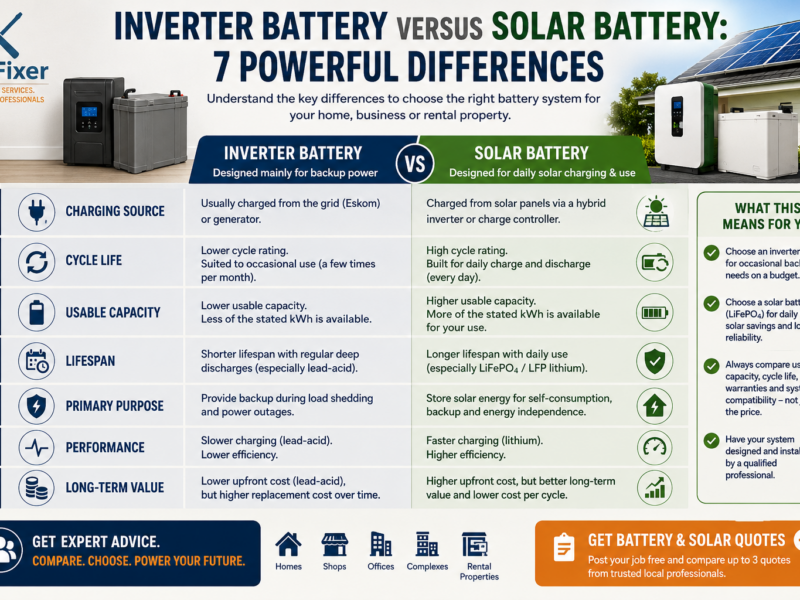
Inverter Battery Versus Solar Battery: 7 Powerful Differences
Load shedding has made battery choices a practical property decision, not just a technical one. When comparing an inverter battery versus solar battery, the right answer depends on how you use power, how often the battery will cycle, and whether solar panels are part of your plan now or later.
A battery that keeps Wi-Fi, lights and a television running through occasional outages may be a poor fit for a home that relies on solar power every day. The same applies to shops, offices and rental properties where downtime, tenant comfort and running costs all matter. Understanding the difference helps you ask installers the right questions and compare quotes on more than the upfront price.
Table of Contents
What is an inverter battery?
An inverter battery stores DC electricity and supplies it to an inverter when grid power fails. The inverter changes that stored electricity into the AC power used by household plugs and appliances.
In South Africa, the term often refers to a battery used mainly for backup power. It may be paired with a trolley inverter, a UPS-style system or a fixed inverter installation. Older systems commonly use lead-acid, gel or AGM batteries, while many newer installations use lithium batteries because they charge faster, last longer and offer more usable capacity.
The battery itself does not decide whether it is being charged by Eskom, a generator or solar panels. Its suitability comes down to its chemistry, battery management system, cycle rating and the charging equipment connected to it.
What is a solar battery?
A solar battery is designed to store electricity produced by photovoltaic solar panels. It is generally built for regular charging and discharging, often every day, rather than only during occasional outages.
Most modern solar battery systems use lithium iron phosphate, also called LiFePO4 or LFP. This chemistry is popular because it offers a long cycle life, stable performance and a lower fire risk than some other lithium types. Solar batteries are usually connected to a hybrid inverter, which manages power from the panels, the battery and the grid.
A solar battery can also provide backup during load shedding, provided the system has been designed with essential loads or suitable whole-property backup. Solar panels alone do not automatically keep your property powered during an outage. The inverter and battery setup must be capable of operating safely when the grid is off.
Inverter battery versus solar battery: the key differences
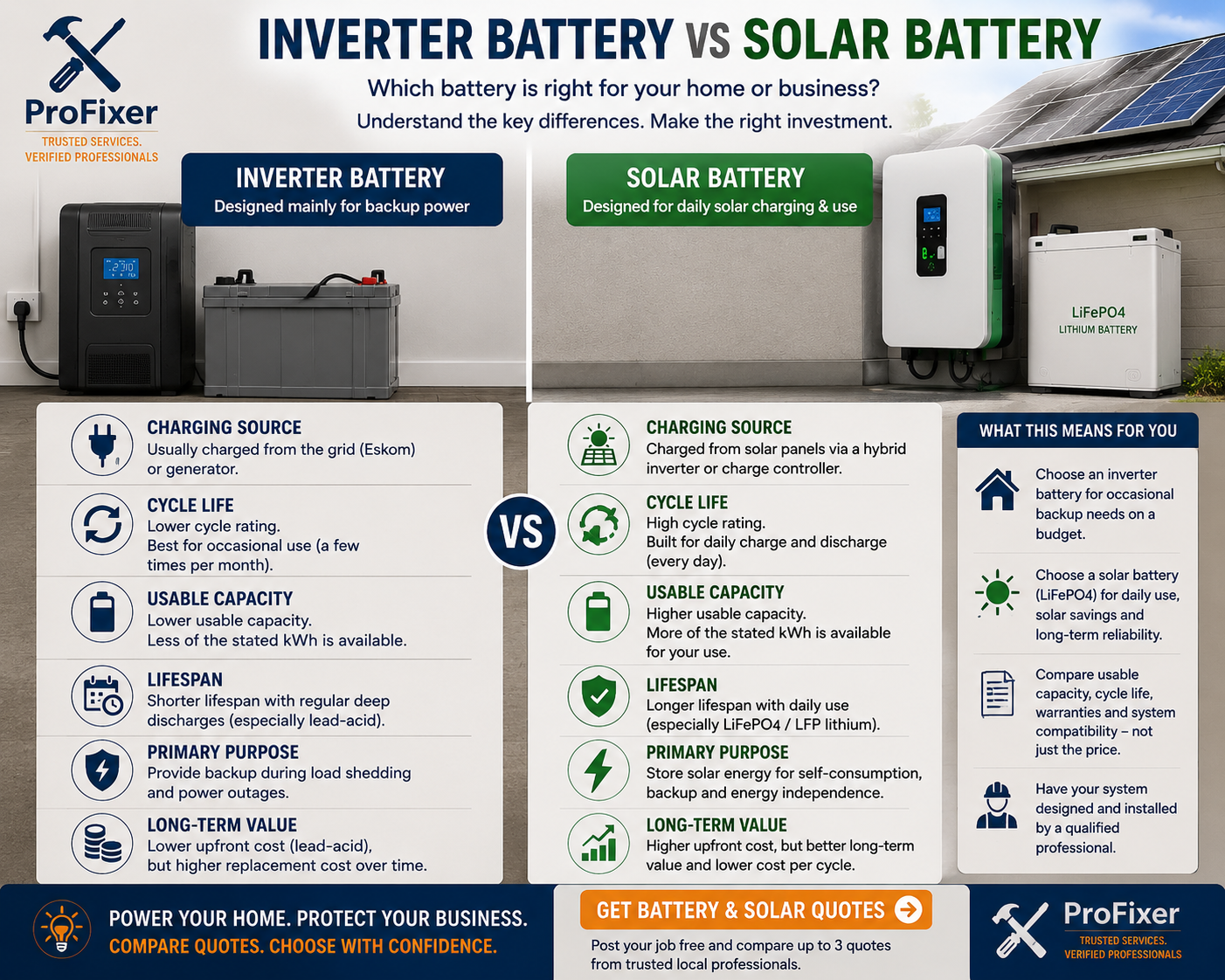
The main difference is not simply the label on the battery. It is the expected duty cycle.
An inverter battery intended for emergency backup might discharge only a few times a month. A solar battery may charge from morning sunlight and discharge after sunset almost every day. That daily use places much greater demand on the battery, so a solar-focused system needs a higher cycle rating and correct charge controls.
Charging source and controls
Backup inverter systems are often charged from the grid. Some can accept solar charging later, but that does not mean every existing battery is ideal for solar use. The inverter needs the right solar input or an appropriate charge controller, and the battery must support the required charge voltage and current.
A purpose-designed hybrid solar system manages several sources automatically. It can prioritise solar generation, charge the battery with surplus power and use the grid when necessary. This can reduce electricity purchases, but the saving depends on panel size, daytime consumption, tariff structure and how the system is configured.
Cycle life and usable capacity
When comparing inverter battery versus solar battery options, cycle life and usable capacity are often more important than the advertised battery size alone.
Cycle life is the number of charge and discharge cycles a battery can deliver before its capacity falls significantly. A battery with a low cycle rating may be acceptable for infrequent load shedding, yet deteriorate quickly if it is deeply discharged every evening.
Usable capacity matters just as much as the battery’s advertised size. A 5 kWh battery does not always provide the full 5 kWh for household use. Manufacturers set a recommended depth of discharge to protect the battery and preserve its warranty. Lithium batteries typically offer more usable capacity than lead-acid units of the same stated size.
Ask a contractor to show the usable kWh, not only the battery’s nominal capacity. It is one of the clearest ways to compare two quotes fairly.
Lifespan and replacement cost
Lead-acid batteries can be cheaper at the start, particularly for a small backup setup. However, they are heavier, slower to charge and usually have a shorter working life when discharged regularly. They can be a sensible option for light, occasional use where budget is tight.
Lithium batteries cost more upfront but normally deliver more cycles, faster charging and better long-term value for frequent backup or solar self-consumption. The best value is not always the least expensive installation. A lower-priced battery that needs replacing sooner can cost more over the life of the system.
Solar savings versus backup only
An inverter battery charged from the grid mainly buys resilience. It helps you carry on during outages, but it does not generate electricity. You still pay to charge it, and some energy is lost during charging and conversion.
A solar battery paired with panels can improve resilience and help you use more of the electricity generated on your roof. It is most useful when your property has meaningful daytime solar production and evening consumption. If your home is empty during the day and uses most electricity late at night, battery storage may be particularly valuable. If the building uses power while the sun is out, more panels or better daytime load management may deliver stronger returns than a larger battery.
Choosing the right system for your property
The right choice between inverter battery versus solar battery depends on whether you mainly need occasional backup or expect the battery to charge and discharge regularly as part of a solar system.
Start with the appliances you need to keep running. For many homes, essential loads include lights, fibre router, television, charging points, security systems and a fridge. A larger system may also support a microwave, washing machine, borehole pump, gate motor or selected air-conditioning, but each item changes the required inverter size and battery capacity.
Do not rely only on appliance wattage printed on a label. Motors, pumps, fridges and some power tools can draw a high surge when starting. An installer should calculate both continuous demand and peak demand, then decide which circuits should sit on the backup supply.
For a small flat or home office, a backup-only inverter and lithium battery may be enough. For a family home with available roof space and regular daytime use, a hybrid inverter with panels and a solar battery is often the more flexible route. For a retail site, medical practice, complex or office, the decision may also require load monitoring, phased installation and a plan for critical equipment.
Questions to ask before accepting a quote
A clear quote should state the inverter make and model, battery capacity in kWh, usable capacity, panel wattage where applicable, expected essential loads and warranty terms. It should also confirm whether installation includes protection equipment, changeover arrangements, compliance documentation and electrical testing.
Ask how long the proposed battery should run under your expected load, rather than accepting a single runtime promise. A system that lasts four hours with lights and Wi-Fi may last far less when a kettle, heater or pump is added.
It is also worth asking whether the system can be expanded. A modular battery bank, spare inverter capacity and suitable distribution-board planning can make future upgrades easier. Expansion is not guaranteed across all brands or models, so get this confirmed before installation.
Installation and safety are part of the decision
Battery performance depends on more than the box mounted on the wall. Correct cable sizing, circuit protection, earthing, ventilation where required, weather protection and a suitable installation location all affect safety and reliability.
A qualified electrician or solar installer should assess the distribution board and confirm which circuits can be backed up. They should also explain what will not run during an outage. This avoids a common disappointment: installing a capable battery system but finding that a desired plug, geyser, stove or gate circuit was never connected to backup.
For landlords and property managers, consider access, tenant usage and responsibility for maintenance before choosing a system. A shared backup system can be valuable, but its load limits need to be clear. Commercial properties should also consider the cost of interrupted trading, security requirements and whether generator integration is needed.
Get the specification before the sale
A good installer will not push the biggest battery without understanding your loads, budget and plans for solar. Request a site assessment, describe what must stay on during outages and compare like-for-like specifications from local professionals.
With Profixer, you can post your battery or solar installation job free and connect with local electricians and solar installers interested in quoting for the work. Compare usable battery capacity, cycle life, inverter compatibility, warranties, installation scope and price before choosing a system.
The inverter battery versus solar battery decision should be based on how frequently the battery will cycle, the loads you need to support and whether solar generation forms part of your long-term plan. Choose the specification first, then have the complete system installed and commissioned by a qualified professional.
GET BATTERY & SOLAR QUOTES