
Find Trusted Drywall Contractors Near You
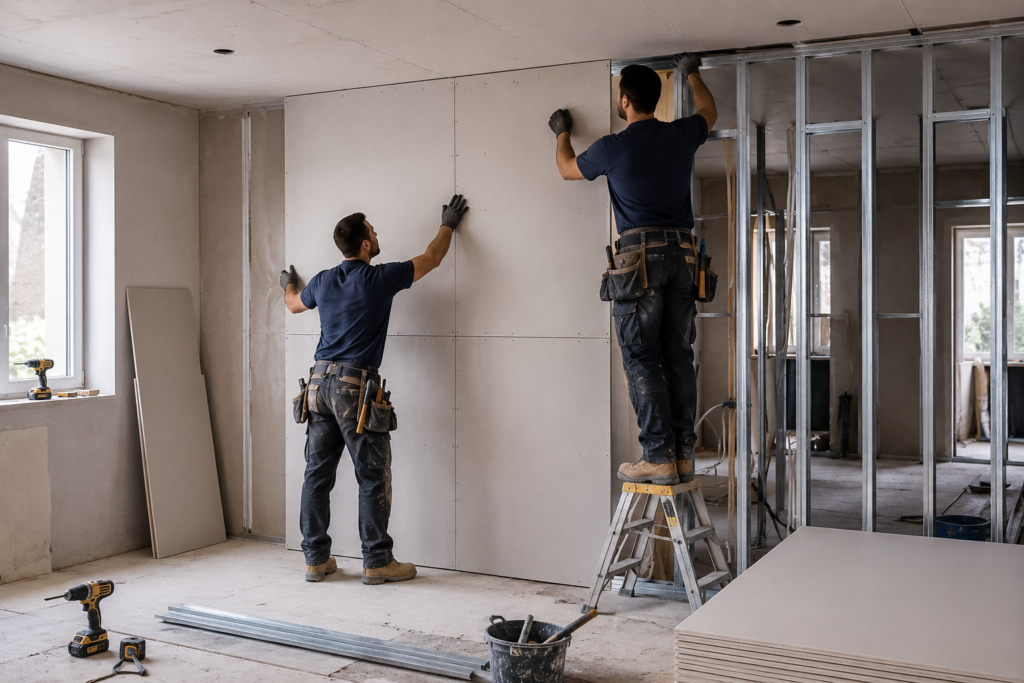
Drywall is widely used to create internal walls, divide rooms, build offices, form ceilings and complete renovation projects without the weight and disruption of traditional brick construction. When it is installed correctly, drywall can provide a neat, practical and flexible finish that is suitable for homes, offices, shops and many other types of property.
Professional drywall contractors can help with everything from a simple bedroom partition to larger commercial fit-outs. They can plan the framework, select suitable boards, install insulation where required, create openings for doors and services, finish joints and prepare the completed surface for painting.
ProFixer makes it easier to find suitable local specialists. Post your drywall job free, describe the work required, upload photographs or measurements where possible and compare up to three no-obligation quotes from contractors serving your area.
Table of Contents
Why Hire Professional Drywall Contractors?
Drywall installation involves more than simply fixing boards to a frame. The supporting structure needs to be straight, securely fixed and correctly spaced so that the finished wall remains stable. Boards must be cut accurately around doors, windows, sockets and other services, while joints need careful finishing to avoid visible lines and cracking after painting.
Professional drywall contractors can assess the room, recommend an appropriate system and coordinate the work with other trades where necessary. A well-planned installation can also make it easier to incorporate insulation, electrical wiring, data cabling and other concealed services.
Drywall contractors may assist with:
- Drywall partition installation
- Internal room divisions
- Office partitioning
- Drywall ceilings
- Drywall repairs
- Feature walls
- Bulkheads
- Sound-insulated walls
- Insulated partitions
- Fire-rated systems
- Renovation work
- Commercial fit-outs
- Jointing and finishing
- Openings for doors and services
The exact system should be selected according to the intended use of the room rather than using the same board and framing arrangement for every project.
How to Find Drywall Installers Near Me
Searching for drywall installers near me can produce many options, but contractors may have very different levels of experience. Some specialise mainly in residential renovations, while others may focus on office partitioning, commercial interiors or larger construction projects.
When requesting quotes, provide:
- Your suburb, town or city
- Photographs of the area
- Approximate wall dimensions
- Ceiling height
- Number of partitions required
- Number of doors or openings
- Whether insulation is required
- Whether electrical services will run inside the wall
- Whether sound reduction is important
- Whether painting is required
- Your preferred completion date
For larger projects, a contractor may need to inspect the property before providing an accurate quotation.
Drywall Partition Installation
Drywall partitions can divide existing rooms without constructing heavy masonry walls. They are commonly used where property owners want to change an internal layout quickly and with less disruption.
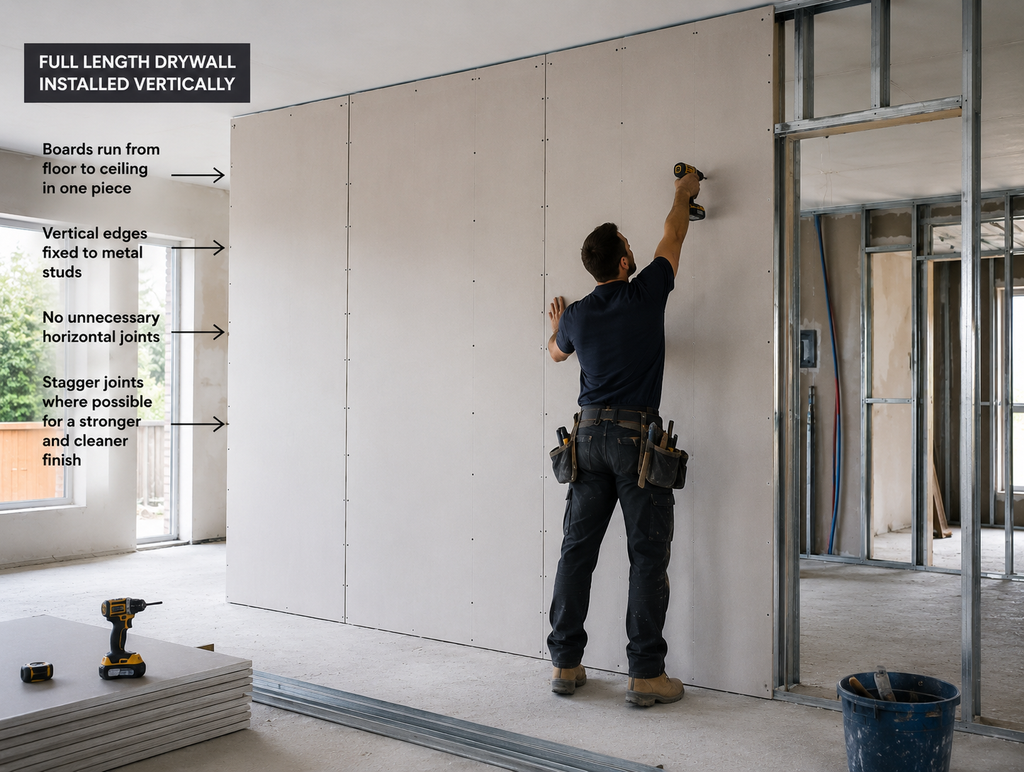
A typical drywall partition may consist of:
- Floor and ceiling tracks
- Vertical studs
- Drywall boards
- Screws and fixings
- Jointing materials
- Corner protection
- Insulation where required
- Openings for doors
- Electrical service openings
- Final finishing
The framework should be accurately aligned before boards are installed because any movement or unevenness in the frame will affect the final wall.
Internal Wall Partitions
Internal drywall walls can be used to create new bedrooms, studies, storage rooms, passages or work areas within an existing building.
Before installing the partition, the layout should consider:
- Door positions
- Furniture layout
- Electrical sockets
- Lighting controls
- Existing windows
- Ventilation
- Ceiling levels
- Floor finishes
- Future access requirements
Planning these details before installation can reduce unnecessary alterations later.
Drywall for Home Renovations
Drywall is particularly useful during renovations because it can create new room layouts without major structural work.
Renovation projects may involve:
- Dividing large rooms
- Creating new bedrooms
- Building walk-in wardrobes
- Forming utility areas
- Creating home offices
- Closing unused openings
- Building feature walls
- Boxing in services
- Reconfiguring passages
The contractor should check whether any existing wall being removed or altered is structural before work begins.
Drywall for House Extensions
House extensions may use drywall internally after the main structure and roof have been completed.
Drywall work in an extension may include:
- Bedroom partitions
- Bathroom divisions
- Passage walls
- Internal linings
- Ceiling work
- Insulation
- Door openings
- Electrical service routes
- Final jointing and finishing
The drywall contractor should coordinate with builders, electricians, plumbers, ceiling installers and painters so that the work is completed in the correct sequence.
Office Partitioning
Drywall is commonly used in offices because internal layouts may need to change as businesses grow or reorganise.
Office drywall partitions can be used to create:
- Private offices
- Meeting rooms
- Reception areas
- Storerooms
- Training rooms
- Corridors
- Staff areas
- Boardrooms
The design should consider sound privacy, lighting, ventilation, electrical outlets, data cabling and access to ceiling services.
Commercial Drywall Contractors
Commercial drywall contractors may work on offices, shops, clinics, schools, guest houses, restaurants and other business properties.
Commercial projects often require careful scheduling because other trades may be working on the same site.
Work may include:
- Partition walls
- Drywall linings
- Suspended features
- Bulkheads
- Service enclosures
- Acoustic partitions
- Fire-rated systems
- Office alterations
- Retail fit-outs
For larger projects, the quotation should clearly specify board types, framework, insulation, finishes and any specialist requirements.
Drywall Ceiling Installation
Drywall can also be used for ceilings where a smooth continuous appearance is required.
Drywall ceiling installation may involve:
- Supporting framework
- Ceiling boards
- Screw fixing
- Openings for lights
- Access panels
- Joint treatment
- Skimming
- Cornices
- Final preparation for painting
The support structure must be correctly designed because inadequate support can contribute to sagging and joint cracking.
Drywall Bulkheads
Bulkheads can be used to add architectural detail or conceal building services.
They are often installed to:
- Hide pipes
- Conceal ducting
- Create lighting features
- Define different room zones
- Lower selected ceiling areas
- Create modern decorative designs
Accurate framing is essential because uneven bulkheads can be very noticeable after lighting and painting are completed.
Drywall Feature Walls
Drywall can also be used to create decorative or functional feature walls.
Feature wall projects may include:
- Television walls
- Recessed shelving
- Display niches
- Decorative recesses
- Fireplace surrounds
- Lighting features
- Storage details
These projects often require detailed measurements and coordination with electrical or carpentry work.
Drywall Around Doors
Door openings need extra attention because the surrounding framework must support both the wall and the door installation.
The drywall contractor may need to provide:
- Reinforced framing
- Correct opening dimensions
- Straight jamb lines
- Suitable lintel framing
- Neat board finishing
- Preparation for door frames
Door dimensions should ideally be confirmed before the partition is boarded.
Drywall Around Windows
Where drywall is installed around existing windows, reveals and edges should be finished neatly.
Work may include:
- Forming straight openings
- Trimming boards accurately
- Installing corner protection
- Closing gaps
- Joint finishing
- Preparing surfaces for painting
Poorly finished window openings can remain visible even after the rest of the wall has been decorated.
Drywall Jointing and Finishing
The quality of the final drywall surface depends heavily on the jointing process.
Joint finishing may involve:
- Joint tape
- Jointing compound
- Multiple finishing coats
- Corner treatment
- Screw-head filling
- Sanding
- Skimming where required
The aim is to create a continuous surface where board joints are difficult to see after painting.
Drywall Skimming
Some drywall installations may receive a skim coat to create a more uniform surface before decorating.
Skimming can help improve:
- Joint visibility
- Minor surface imperfections
- Previous repair areas
- Overall smoothness
- Preparation for high-quality paint finishes
The contractor should ensure that the board joints and fixings are stable before applying final finishes.
Drywall Repair Contractors
Professional drywall repair contractors can repair damaged sections without necessarily replacing an entire wall.
Repairs may be required because of:
- Impact damage
- Water leaks
- Electrical work
- Plumbing repairs
- Removal of fixtures
- Door alterations
- Cracked joints
- Accidental holes
The damaged area should be cut back to sound material before new board and jointing materials are installed.
Repairing Holes in Drywall
Holes can range from small fixing marks to larger areas damaged by impact or previous construction work.
Small repairs may require filling and finishing, while larger openings may need:
- Additional backing
- Replacement board sections
- Joint tape
- Jointing compound
- Sanding
- Repainting preparation
A good repair should blend into the surrounding surface rather than leaving an obvious raised patch.
Cracked Drywall Repairs
Cracks commonly develop along board joints, corners or areas where movement occurs.
Possible causes include:
- Poor joint preparation
- Loose framing
- Building movement
- Incorrect fixing
- Moisture
- Temperature changes
Simply filling the visible crack may not provide a lasting repair if the underlying movement continues.
The contractor should investigate why the crack formed before refinishing the area.
Water-Damaged Drywall
Drywall can deteriorate quickly when exposed to ongoing water leaks.
Signs of water damage may include:
- Staining
- Swelling
- Soft boards
- Mould
- Peeling finishes
- Sagging
- Crumbling material
Before replacing damaged drywall, the source of moisture should be repaired and the area allowed to dry properly.
Possible causes may include roof leaks, plumbing faults, bathroom leaks or waterproofing failures.
Drywall Repairs After Plumbing Work
Plumbing repairs sometimes require walls to be opened so that hidden pipes can be accessed.
Once the plumbing problem has been repaired and tested, a drywall contractor can close and finish the opening.
The work may involve:
- Replacing board sections
- Restoring insulation
- Repairing framing
- Joint treatment
- Skimming
- Preparing for painting
The wall should not be closed until the plumbing repair has been confirmed as leak-free.
Drywall Repairs After Electrical Work
Electrical work may require access through drywall to install cables, sockets, switches or other equipment.
After the electrical installation is complete, drywall repairs can restore the wall.
Repair work may include:
- Closing cable access holes
- Replacing cut board sections
- Repairing around outlets
- Jointing
- Sanding
- Preparing for paint
Electrical work should normally be completed before final drywall finishing.
Insulated Drywall Partitions
Insulation can be installed inside drywall partitions to improve thermal comfort or reduce sound transmission.
Insulation may be useful in:
- Bedrooms
- Home offices
- Meeting rooms
- Studios
- Rental properties
- Commercial offices
- Rooms adjoining garages
- Shared internal walls
The type of insulation should suit the performance required and the available wall cavity.
Soundproof Drywall Systems
Standard drywall partitions provide some separation between rooms, but additional measures may be needed where improved sound privacy is required.
Sound-reducing systems may include:
- Acoustic insulation
- Multiple board layers
- Specialist acoustic boards
- Staggered framing
- Sealing around gaps
- Acoustic treatment around doors
The required system will depend on whether the aim is simply to improve privacy or achieve a higher level of sound control.
Fire-Rated Drywall Systems
Some buildings or specific areas may require fire-rated drywall systems.
These systems may use:
- Specialist fire-rated boards
- Approved framing arrangements
- Specific fixing patterns
- Fire-resistant joint treatment
- Suitable insulation
- Fire-rated service penetrations
Fire-rated work should follow the appropriate system specifications rather than mixing unrelated products.
Moisture-Resistant Drywall
Rooms exposed to higher humidity may require boards suitable for moisture-prone conditions.
Applications may include:
- Selected bathroom areas
- Kitchens
- Utility rooms
- Laundry areas
- Some commercial spaces
Moisture-resistant drywall is not a substitute for proper waterproofing where surfaces are exposed directly to water.
Drywall for Rental Properties
Landlords may use drywall to alter layouts, create additional rooms or repair damage between tenants.
Common rental-property projects may include:
- Repairing holes
- Rebuilding damaged partitions
- Creating extra bedrooms
- Dividing living areas
- Repairing water-damaged sections
- Closing unused openings
- Preparing walls for repainting
Where layouts are being changed significantly, property owners should confirm that the proposed work complies with relevant building requirements.
Drywall During Property Renovations
Drywall installation often takes place alongside ceiling, plastering, electrical, plumbing and painting work.
The order of work matters. Electrical and plumbing services should normally be positioned within the wall cavity before both sides of the partition are fully closed.
Good coordination can reduce the need to reopen newly finished walls.
Drywall Before Painting
Drywall should be properly finished before paint is applied.
The surface should be:
- Dry
- Smooth
- Clean
- Free from loose dust
- Properly jointed
- Sanded where required
- Primed appropriately
Strong lighting can highlight imperfections in jointing and sanding, so good preparation is important for the final appearance.
Drywall Demolition and Removal
Renovations may involve removing existing drywall partitions before a new layout can be created.
Removal work may include:
- Taking down boards
- Removing framing
- Removing insulation
- Disconnecting services safely
- Sorting waste
- Preparing surrounding surfaces
Electrical or plumbing services hidden inside the wall should be identified before demolition begins.
Reconfiguring Existing Drywall Partitions
Existing drywall walls can sometimes be altered rather than completely rebuilt.
Alterations may include:
- Moving door openings
- Closing doors
- Adding new openings
- Extending partitions
- Shortening walls
- Adding reinforcement
- Modifying electrical services
A contractor should inspect the existing framing before deciding whether it can be reused.
Drywall for Retail and Shop Fit-Outs
Retail spaces frequently use drywall because layouts, display areas and storage spaces may need to be created quickly.
Shop fit-outs may involve:
- Stock rooms
- Changing rooms
- Display walls
- Staff areas
- Service enclosures
- Bulkheads
- Ceiling details
Commercial projects may also need to coordinate with lighting, air conditioning, security systems and fire equipment.
Drywall for Schools and Clinics
Schools, clinics and similar facilities may require partitioning for classrooms, consultation rooms, offices and storage spaces.
These projects may require greater attention to:
- Durability
- Sound privacy
- Fire performance
- Accessibility
- Service routing
- Easy maintenance
The contractor should understand the requirements of the specific environment before proposing a system.
What Affects Drywall Installation Costs?
The cost of hiring drywall contractors depends on the size of the project, materials, wall height and the level of finishing required.
Costs may be affected by:
- Total wall area
- Ceiling height
- Number of partitions
- Board type
- Framing type
- Insulation
- Door openings
- Window openings
- Electrical services
- Soundproofing
- Fire-rated systems
- Joint finishing
- Skimming
- Access
- Waste removal
A basic residential partition may cost significantly less than a specialist acoustic or fire-rated commercial system.
What Affects Drywall Repair Costs?
The price of drywall repairs depends on the extent of the damage and whether framing or hidden services are also affected.
Repair costs may be influenced by:
- Hole size
- Water damage
- Frame damage
- Joint cracking
- Access
- Board type
- Number of repair areas
- Skimming
- Repainting requirements
Small isolated repairs may be relatively straightforward, while widespread water damage may require several boards to be replaced.
What Should a Drywall Quote Include?
A professional quotation for drywall installation services should clearly explain the proposed system and work included.
The quote may specify:
- Total wall or ceiling area
- Framing system
- Board type
- Number of board layers
- Insulation
- Door openings
- Joint treatment
- Skimming
- Corner finishing
- Access requirements
- Waste removal
- Labour
- Estimated duration
- Whether painting is included
- Whether VAT is included
Ask contractors to identify exclusions clearly so that quotations can be compared fairly.
Questions to Ask Drywall Contractors
Before choosing a contractor, ask:
- What drywall system do you recommend?
- What type of board will be used?
- Is insulation included?
- How will the framework be constructed?
- Are door openings included?
- Is jointing and finishing included?
- Will the wall be ready for painting?
- Can electrical wiring be installed inside the partition?
- Do I need soundproofing?
- Is a fire-rated system required?
- How long will the work take?
- Is waste removal included?
- What could increase the final cost?
A detailed discussion before work begins can help prevent disputes about the expected finish and scope.
Compare Drywall Contractors Through ProFixer
Finding suitable drywall contractors can take time, particularly when different contractors recommend different board types, framing systems and finishes.
ProFixer allows you to post one request and connect with local drywall specialists interested in completing the work. Include measurements, photographs and a description of the new layout or repairs required.
Compare contractors based on their experience, proposed drywall system, material specification, workmanship, completion time and total quotation.
Post Your Drywall Job Free
Whether you need reliable drywall installers near me, professional drywall installation services, experienced drywall repair contractors or specialist drywall partition contractors, ProFixer can help you connect with suitable local professionals.
Post your drywall job free and compare up to three no-obligation quotes from local contractors.
POST MY DRYWALL JOB FREE